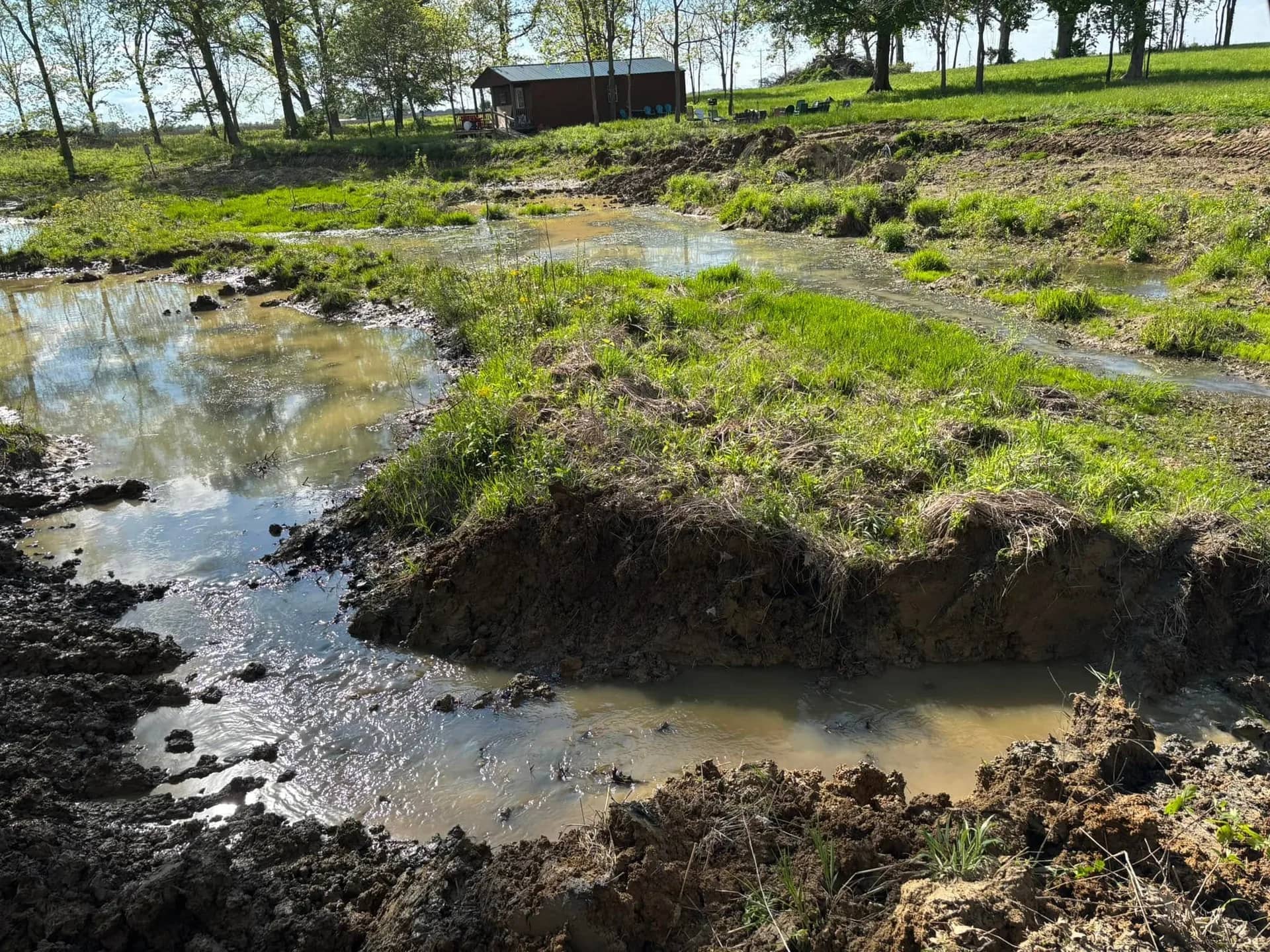
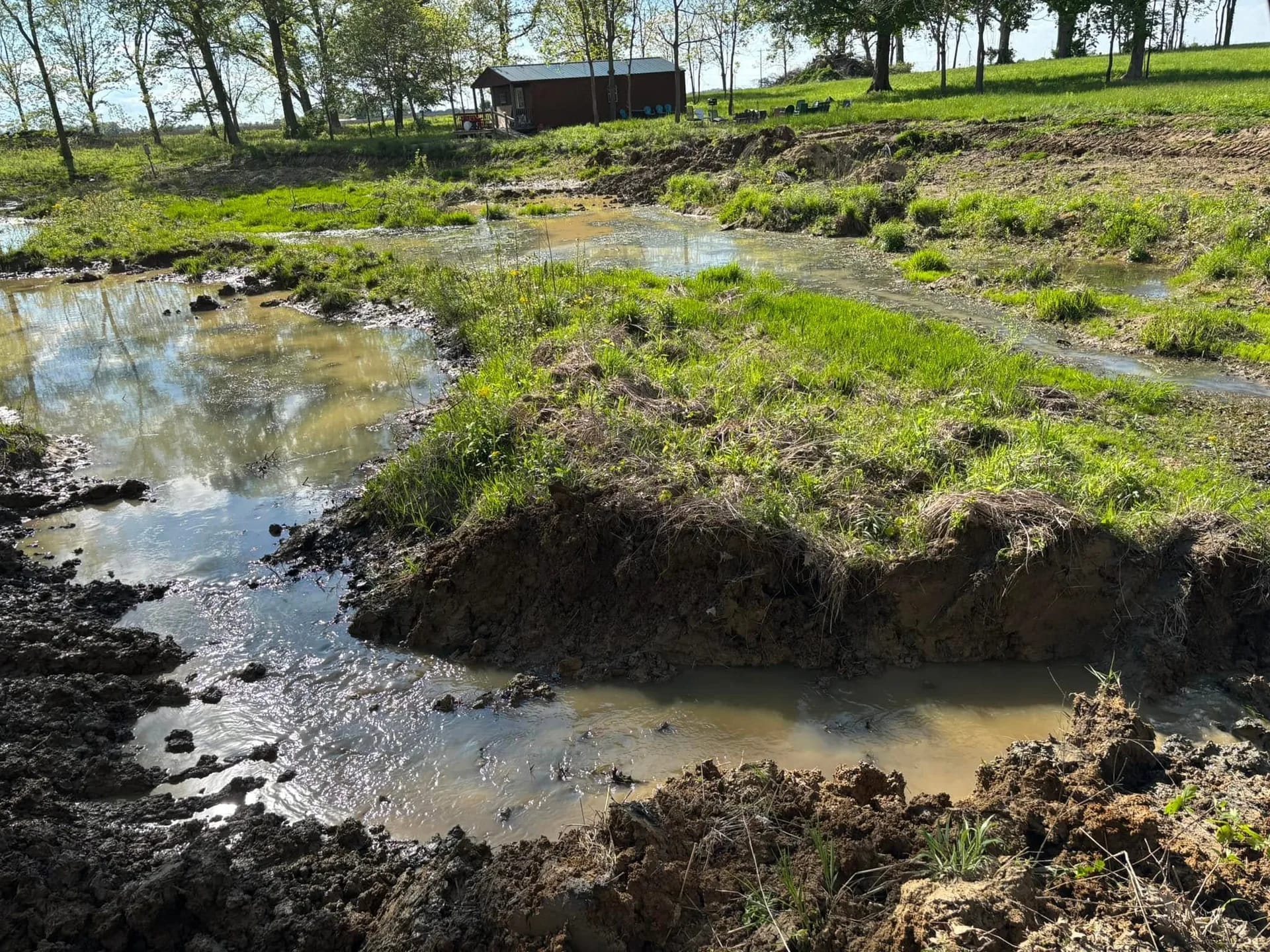
Ponds and lakes
Lake Dredging Services in Rosedale, IN
A lake job is mostly logistics: knowing how much sediment is down there, getting machines to it without tearing up the shoreline, and keeping trucks moving for weeks. Here's how K&H runs one.
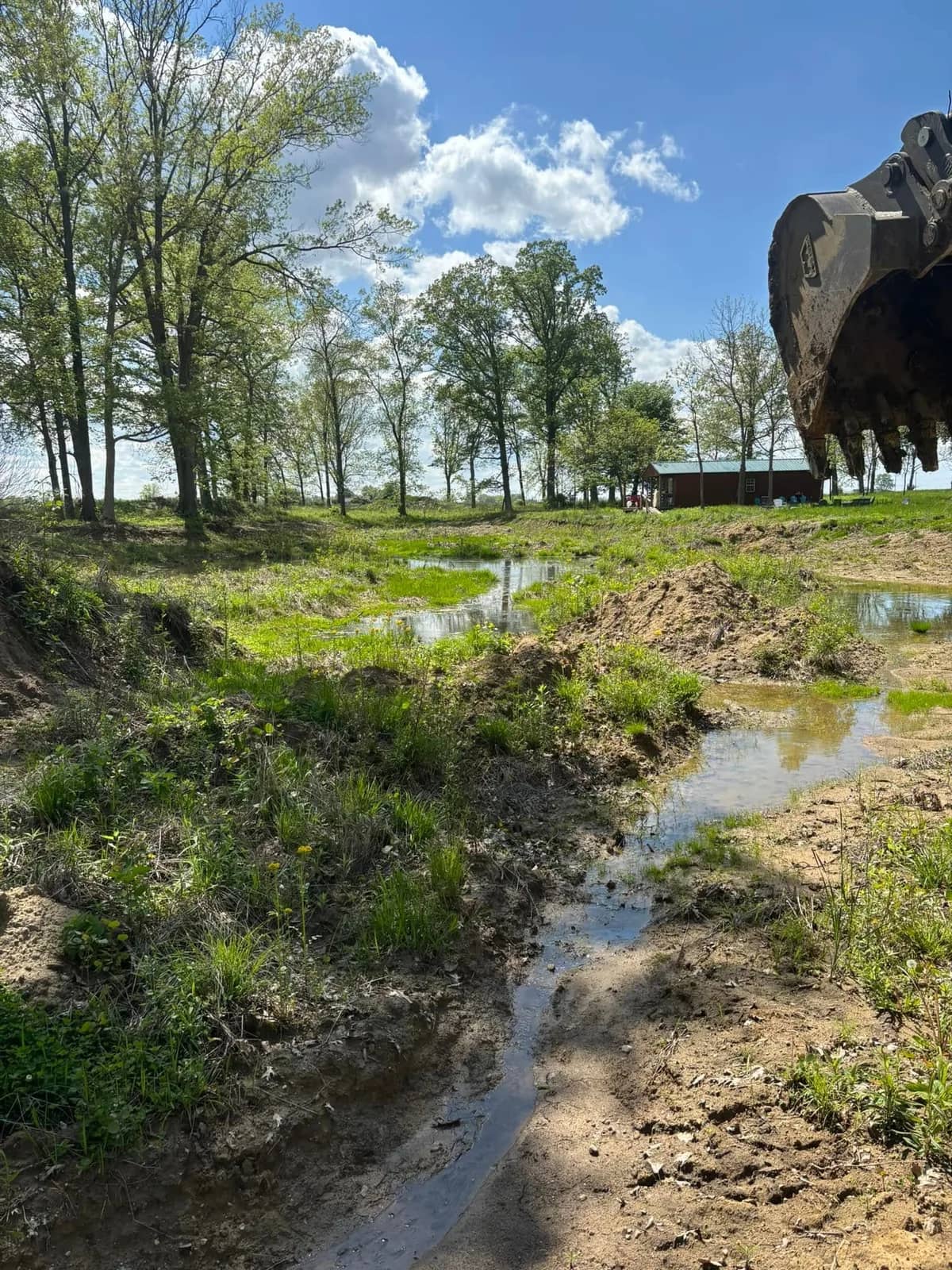
K&H Excavating provides lake dredging services for private lakes, lake associations, and conservancy districts in west central Indiana, and this page walks through how a job actually runs. It's mechanical lake dredging: excavators dig from the bank, or from a barge when a cove calls for one, trucks haul to an upland spoil site, and dozers shape the spoil when it dries. Kory Stone owns this Rosedale excavating company, based in Parke County about 15 miles from Raccoon Lake on US-36. Kory plans the soundings, access roads, mats, and haul routes himself, and he's on site when the digging starts. For the permit side and an overview of lake work, see our lake dredging guide for owners and associations. To start planning, call or text Kory at (765) 548-3704.
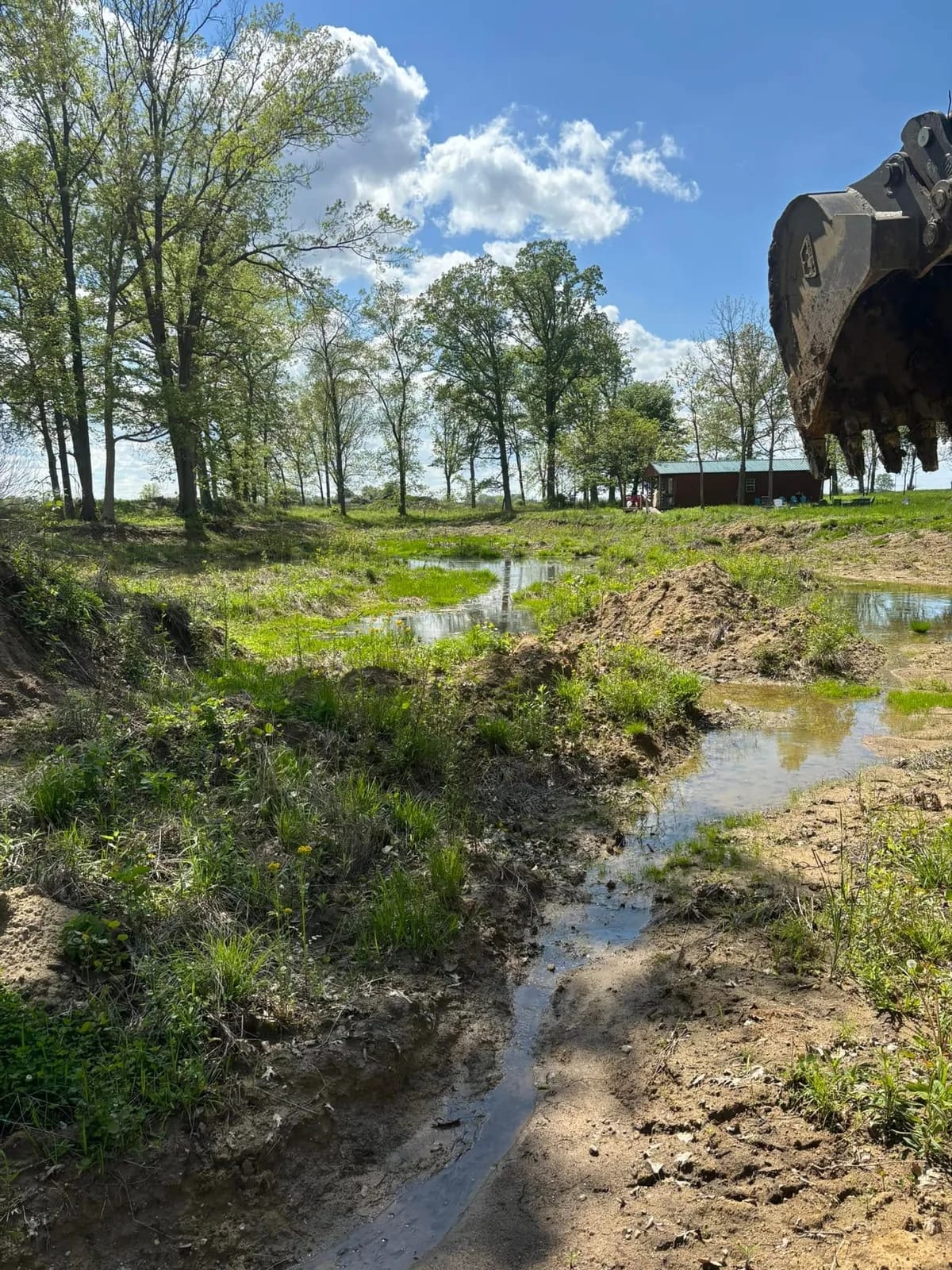
When to call
Signs Your Association Is Ready to Hire a Lake Dredging Company
Most lakes are ready for dredging long before the paperwork is. The time to bring in a contractor is when the plan, the money, and the water level start lining up, because a missed fall window can push the digging back a full season. Spring is the wettest season in the Wabash Valley, and that's when shorelines are softest.
- A depth survey or soundings show which coves and inlets need the most work.
- Your permits are issued, and they spell out a work window you have to hit.
- A LARE award came through, and the program requires at least three bids.
- A drawdown is scheduled for dam, spillway, or seawall repair.
- The silt ponds above the lake have been cleaned, so dredging the lake will last.
- A hydraulic quote came back sized for open water when your problem is a handful of coves.
- Residents are grounding boats, and the board has voted to fix it before next summer.
What's included
What Our Lake Dredging Services Include
Every K&H lake job is mechanical lake dredging, run in the same order: measure, build access, dig, haul, restore. The order matters because each step sets up the next one.
Soundings and a Volume Estimate
Kory takes depth readings on a grid across each work area, recording water depth and the depth of soft sediment to firm bottom. That gives a cubic-yard figure for each cove, which sets truck counts, schedule, and price. LARE-funded projects also call for post-dredging mapping of the lake bottom, so the same readings get repeated at the end to show what came out.
Access Roads, Mats, and Staging
Machines and loaded trucks are heavy, and lakefront lawns and creek-bottom banks are soft. K&H builds a staging area for equipment, a turnaround for trucks, and temporary access with stone or timber mats where the ground won't carry the load. Before any digging on the banks, Kory places the Indiana 811 locate request at least two full working days ahead.
Long-Reach or Excavator-on-Barge
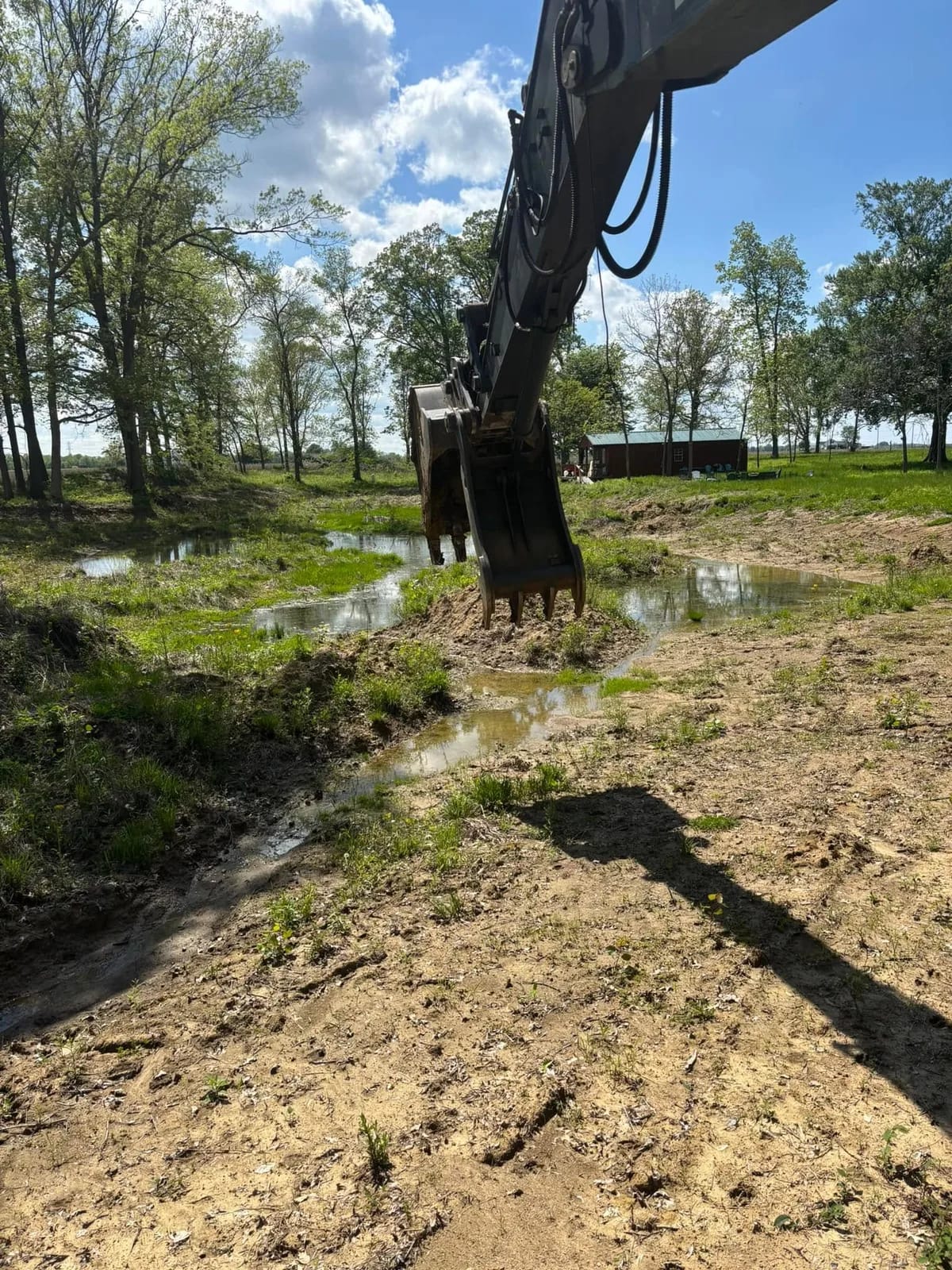
Most coves get dug from shore. Long-reach excavators reach roughly 50 to 65 feet from the bank, according to manufacturer specs, which covers a lot of cove work, and K&H brings one in when the job calls for it. Where reach runs out, an excavator on a barge can dig the middle of a cove and load material back to shore. Either way, the dredging is mechanical, with excavators rather than a hydraulic suction dredge.
Haul Routes and Spoil Placement
Spoil leaves the shoreline by truck or dozer on a route planned before mobilization, often on narrow association roads past homes. K&H hauls on its own trucks, and Kory sets truck hours and routes with the board. At the upland spoil site, silt fence goes up first, the material drains, and dozers spread and shape it once it's dry enough to work.
Local ground
The Lake Job Problems We See Most in West Central Indiana
Creek-valley alluvium covers about 14% of Parke County, 21% of Vigo, and 29% of Clay, according to Indiana Geological and Water Survey mapping. That's the ground many lakes sit in, and it's why mats and stone come before machines. Overnight lows average below freezing December through February, and frozen ground can let machines reach spots they can't in spring.
In 2024, IDEM's public notice for a cove project on Lake Holiday in Fountain County described "1-step removal using a barge with an excavator," taking about 6,900 cubic yards from a cove of roughly 14.2 acres, with spoil hauled by truck to a man-made sediment basin (IDEM Section 401 notice). That wasn't a K&H job, but it shows how a barge solves the reach problem on a wide cove close to home.
Weeks of loaded trucks on roads built for cars and golf carts wear on residents and pavement. Kory picks the shortest route to the spoil site and sets truck hours, and road condition and repairs get settled with the board before the first load. When the best spoil site needs its own access road or grading, that's general excavation work K&H handles too.
Rain softens access roads and slows spoil drying, so a lake schedule has to carry slack. Large jobs often get phased. Indiana's 23-acre Spring Mill Lake, for example, was planned for about 40,000 cubic yards in two phases over two or three years. Smaller cove work can often be done in a single season, and spot jobs are covered on our lake sediment removal page.
Why K&H
Why Associations Hire K&H as Their Lake Dredging Company
A lake board hiring a lake dredging company wants three things: the right machines, one person accountable, and someone who answers. Here's how K&H covers each.
Dredging is excavator work, and spreading wet spoil is dozer work. K&H shows up with both, not a compact loader trying to do a big machine's job on soft ground.
On a job that runs for weeks, the board needs one name. Kory plans the job, runs it, and handles the haul route questions himself, so nothing gets lost between a foreman and an office.
A resident's complaint about a truck at 7 p.m. shouldn't wait until Monday. Kory answers the phone 8 a.m. to 6 p.m., Monday through Saturday, and replies to texts after hours, so your board gets an answer the same evening.
Kory has the trucks to haul spoil himself, which keeps the dig and the haul on one schedule instead of waiting on a hired trucking outfit. See how Kory got K&H started.
How it works
How Our Lake Dredging Services Work
Step 1 — Survey the Lake With Kory
Kory walks or boats the lake with your owner, board, or manager, marking each work area, the inlets feeding them, possible spoil sites, and the roads a truck could use. He takes soundings across the areas you want dug. You get a written estimate with a cubic-yard figure for each area.
Step 2 — Set Access, Spoil Site, and Schedule
With the soundings in hand, Kory picks the spoil site, lays out the access route and staging area, and builds a schedule around your permit conditions and any drawdown. He explains which permits probably apply; the owner or association files. Haul routes and truck hours get worked out with the board so residents know what to expect.
Step 3 — Mobilize and Build the Haul Road
K&H moves equipment in, places the 811 locate, lays mats or stone, and puts up silt fence at the spoil site. Clemson Extension says double silt fencing is typically used around stockpiled dredge material, and that goes up before the first truckload arrives.
Step 4 — Dredge Area by Area, Week by Week
The excavator works one area at a time to target depth, loading trucks that run the planned route. Kory sounds each area again when it's done, and the board's contact can call or text him for an update at any point. Dozers spread the spoil as it dries.
Step 5 — Demobilize and the Final Walk-Around with Kory
Mats and stone come out, ruts get graded, and bare ground is seeded (Clemson recommends within two weeks). You tour the finished areas with Kory by boat or on foot, review the final depths, and look over the spoil site and roads before he loads up.
How we quote
How Much Do Lake Dredging Services Cost in West Central Indiana?
Lake jobs are priced after soundings, because the cubic yards and the work it takes to move them drive the cost. For scale, an acre of lake bottom with a foot of sediment on it holds about 1,613 cubic yards (43,560 cubic feet ÷ 27), and every yard has to be dug, loaded, hauled, and spread. Your number comes from Kory's soundings on your lake, not from a rate card.
K&H takes cash, check, and credit card. Kory can go over payment options with your board when he delivers the quote.
What changes the price
- Total cubic yards from the soundings.
- Mobilization: moving machines in and building staging and access.
- Equipment. A long-reach or barge setup costs more than standard reach from shore.
- Haul cycle. A short, flat run to the spoil site keeps trucks moving; a long route through a lake community slows every load.
- Weather days and drying time at the spoil site.
- Restoration of lawns, banks, and access lanes.
Quoted separately
- Engineering, permit applications, and any survey work done by others
- Road resurfacing, seawall, or dock repair
- Upstream basin cleanouts (silt pond maintenance)
Related work
Often Paired With Lake Dredging Services
Mobilizing for a lake job is a big part of the cost, so it makes sense to handle nearby work while the machines are there.
Lake Sediment Removal
Smaller trouble spots like a swimming beach, a ramp, or a single inlet delta can be added to the job while the equipment is on site. See sediment removal for coves, beaches, and ramps.
Silt Pond Maintenance
The basins above the lake are the reason it stays deep after dredging. Planning a lake job is the right time to look at those feeder ponds too. See silt pond and sediment basin maintenance.
General Excavation
Spoil sites often need grading, a low spot filled, or an access lane cut before trucks can use them, and that's ordinary dirt work. See general excavation for spoil sites and access.
More in Lake Dredging: Lake Dredging · Lake Sediment Removal
Where we work
Lake Dredging Services Across the Wabash Valley and West Central Indiana
Home base is Rosedale, in the southern end of Parke County. Lake projects within about 50 miles are routine, and for the right job Kory will mobilize up to about 75 miles, including into eastern Illinois. The bulk of the work falls in Clay, Vigo, Parke, Putnam, and Vermillion counties. To the southeast, county roads reach IN-59 at Brazil, and IN-46 runs east from there through Spencer in Owen County and on to Bloomington and Lake Monroe. Terre Haute is about 16 miles down US-41, where I-70 heads east toward Indianapolis and west with US-40 toward Marshall, Illinois. IN-163 crosses the Wabash at Clinton and heads toward the Illinois line.
Ground decides how a lake job is staged. In the creek bottoms around Rosedale, soft alluvium means mats and stone. On strip-mine ground in Clay and Vigo counties, steep pit walls limit where an excavator can sit. Around Bloomington and in Owen County, limestone sits close to the surface with mapped sinkhole areas, so spoil sites and access roads get planned around them.
Need lake dredging services near Bloomington or Indianapolis? We serve Rosedale, Terre Haute, Bloomington, Lafayette, and Indianapolis. See all of K&H's excavation services.
Want to know if K&H can mobilize to your lake? Call or text Kory at (765) 548-3704.
Questions
Lake Dredging Services FAQ
How long will equipment and trucks be at our lake?
It depends on the cubic yards, the haul distance, and the weather. A single cove is a short stay by comparison, while a multi-area job can run for weeks. Kory will lay out a realistic timeline on the walk-through and let you know if weather pushes it.
Do you dredge from shore or from a barge?
From shore whenever the reach allows, because it's simpler and keeps machines on solid ground. Long-reach excavators reach roughly 50 to 65 feet from the bank. Where a cove is too wide, an excavator on a barge can dig the middle and bring material to shore, the method IDEM's 2024 Lake Holiday notice described.
What is mechanical lake dredging, and when is hydraulic better?
Mechanical lake dredging digs sediment with an excavator and moves it by truck or dozer; hydraulic dredging pumps sediment as slurry through a pipeline, as Clemson Extension describes. K&H works mechanically, and the lineup is excavators and dozers — no skid steers. Mechanical work suits coves, inlets, and shorelines near a spoil site. For a large open lake with a long pumping run to a disposal area, a hydraulic contractor may be the better fit.
How do you protect lawns, seawalls, and roads?
With planning before the first machine arrives. Mats or stone go down wherever ground or turf is soft, equipment stays back from seawalls, and Kory runs trucks on one agreed route and schedule. Afterward, ruts are graded and bare ground is seeded.
What does the association need to have ready before we mobilize?
Permits in hand (or a clear answer that none are needed), a signed spoil site, access permission across any private lots, and a decision on drawdown timing. Owner Kory on every job means you work these out with the same person who will run the job. A point of contact on the board helps keep resident questions moving.
Can work continue through the winter?
Sometimes. Overnight lows average below freezing December through February around Terre Haute, and frozen ground can carry machines across ground that's too soft in spring. Spoil won't dry in the cold, though, and frozen material can't be graded well. Kory will tell you whether your ground and schedule make winter work practical.
How do we reach Kory once the job starts?
Texts answered after hours means the board and residents aren't stuck waiting for office hours. Phone calls get picked up Monday through Saturday from 8 a.m. to 6 p.m. Kory is on site most days, so a question about a truck or a dock can often be answered in person.
Ask Kory About My Lake Project
Still have a question about lake dredging services? Call or text Kory at (765) 548-3704.
Call or text
Ask Kory about lake dredging services
(765) 548-3704Calls and texts answered Monday to Saturday, 8 a.m. to 6 p.m. Text a few photos of the property and Kory can give you a head start before the site walk.
Get a free estimateFree estimate
Let's Plan Your Lake Job From Soundings to Seed
Bring Kory in early, before the permits and the drawdown are set, and he'll help you build a plan that fits your lake, your roads, and your schedule. Reach him through our contact page, or call or text directly.