
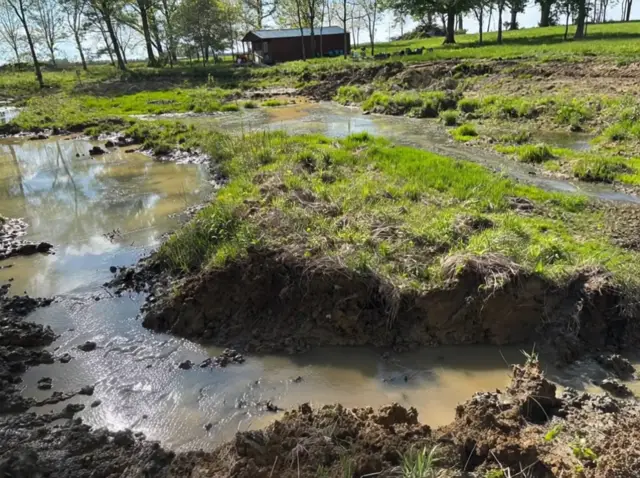
Ponds and lakes
Pond Sediment Removal in Rosedale, IN
Half the depth it used to have? Black muck that swallows a boot, and cattails closing in from every side? The fix is to draw the pond down and dig it back to the clay it was built on.
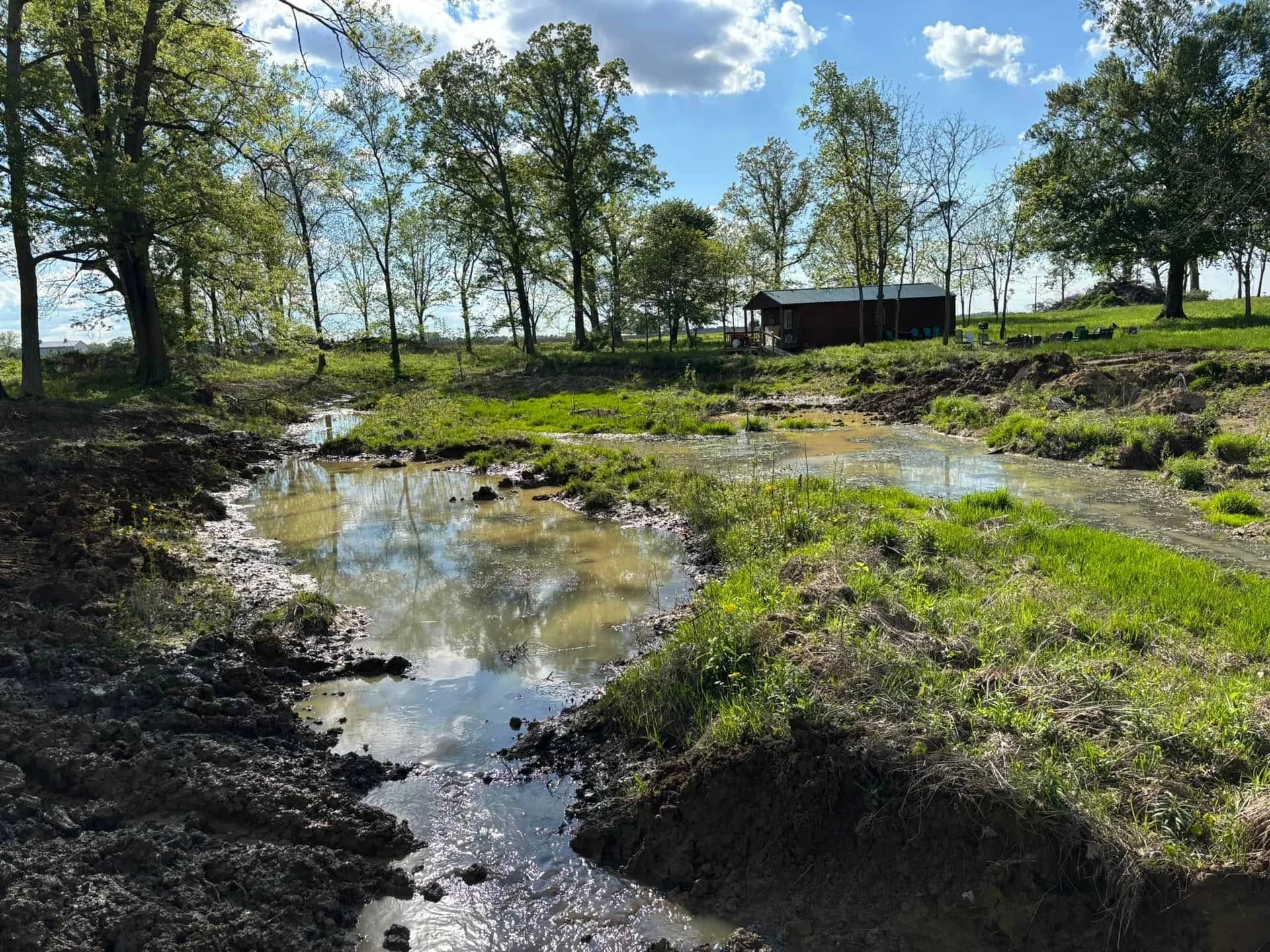
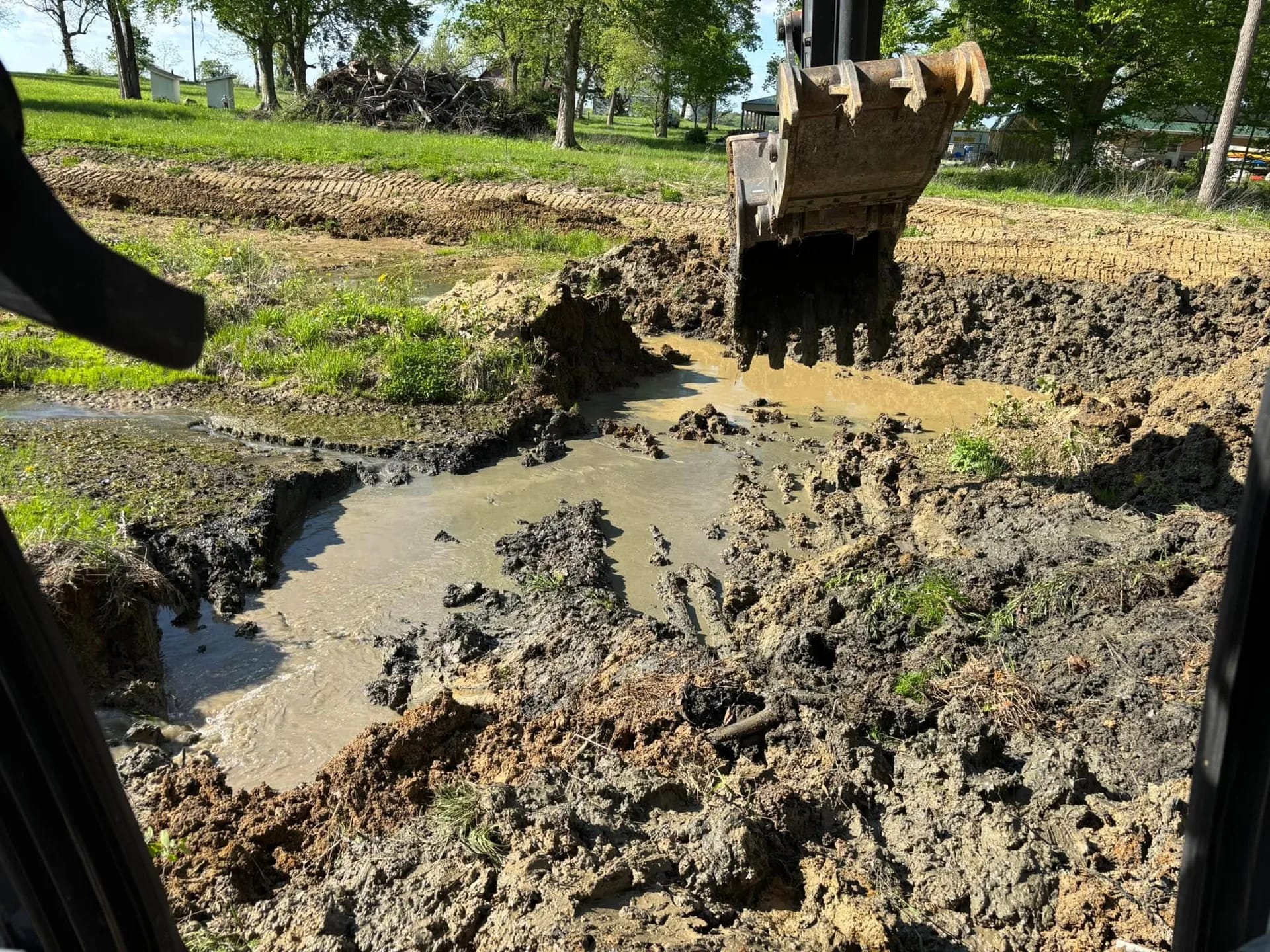
Pond sediment removal at K&H Excavating is a full-basin cleanout: lower the water, let the bottom firm up, and dig out the muck and silt down to the original clay. It's the job for a pond filled in too far for an inlet dig to fix, and one piece of the pond dredging work K&H does across west central Indiana. Owner Kory Stone runs this excavating company out of Rosedale, Indiana, close enough to Big Raccoon Creek to know how much soil a spring rain moves. He digs with excavators and dozers, keeps muck and mineral silt sorted, spreads the spoil upland or hauls it off on K&H's trucks, and reshapes the basin before the water comes back. Call or text Kory at (765) 548-3704 to set up a walk around your pond.
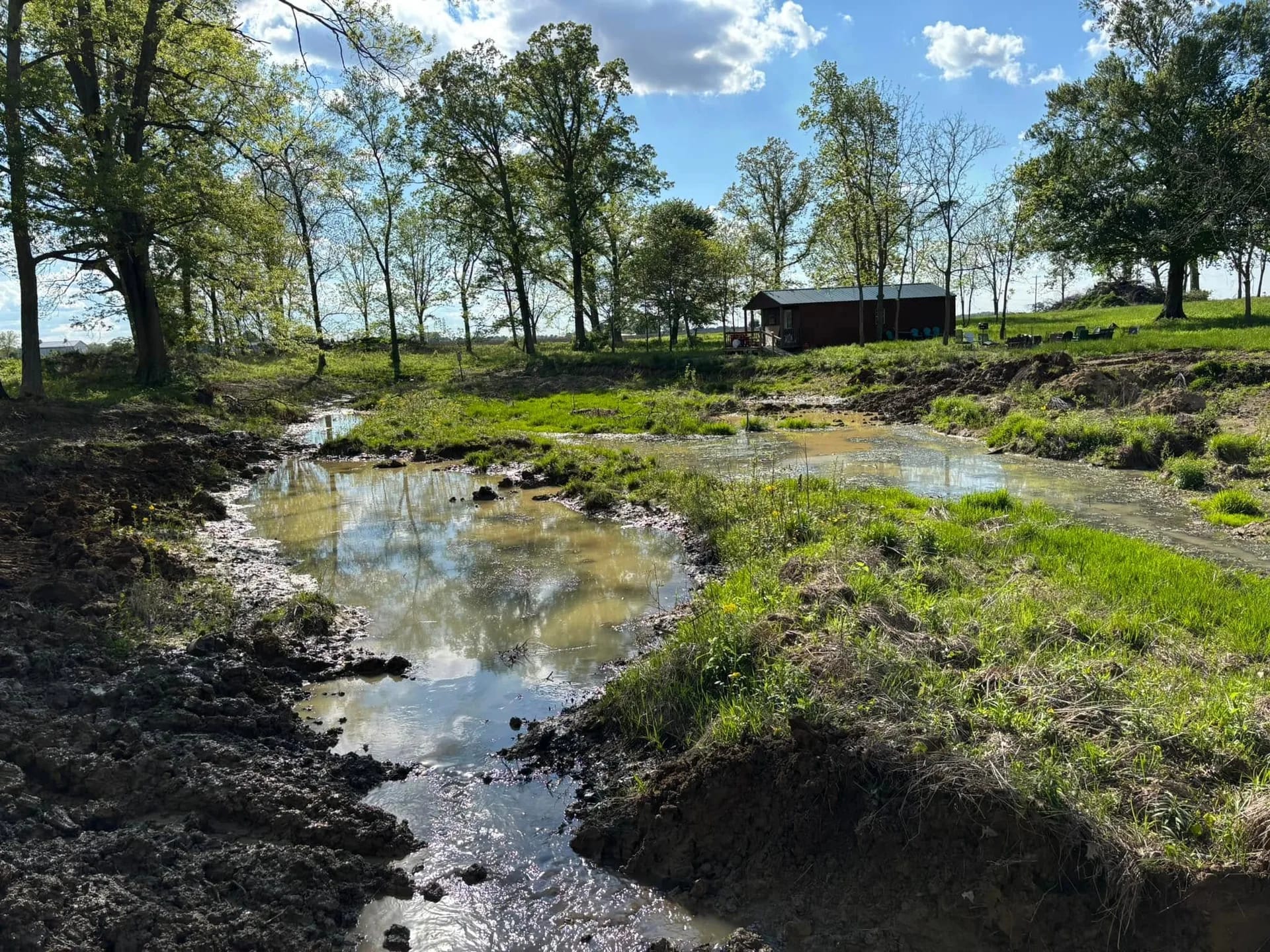
When to call
When Restoring Pond Depth Can't Wait
A filling pond speeds itself up. As water gets shallower it warms faster, and Purdue Extension says rooted plants take hold wherever the water is less than about four feet deep. Those plants die back every fall and add to the muck, which makes the pond shallower still. Fish lose room too: Purdue and Indiana DNR both put five feet as the minimum depth for fish to make it through winter. Every season you wait adds cubic yards to the job.
- Most of the pond is now shallower than four feet, and weeds cover water that used to be open.
- Your boot sinks past the ankle in black, sour-smelling muck at the edge.
- The deepest spot is down to a few feet, and you're worried about fish making it through the winter.
- Silt hasn't stayed at the creek mouth; it has spread across most of the bottom.
- You've treated the water with bacteria, dye, or aeration for years and the pond keeps filling in.
- Cattle bog down at the bank or wade far out to find a drink.
- You bought or inherited ground with an old pond and want it usable before you build the house that looks over it.
What's included
What Our Pond Sediment Removal Includes
Removing sediment from a pond the full-basin way means lowering it enough to work dry, sorting what comes out, and leaving a basin shaped to stay deep longer.
Drawing the Pond Down
Clemson Extension notes that lowering a pond lets the sediment drain on its own before removal, so the cleanout starts with the water. If the pond was built with a drain valve on the spillway pipe, Kory opens it. If not, it comes down by siphon or pump. Indiana DNR's pond booklet suggests draining in fall and letting spring runoff refill the basin. Fish need a plan before the water drops.
Digging It Dry, Down to the Original Bottom
Once the exposed bottom crusts and firms, the excavator works from the bank and from firm ground in the basin, and the dozer pushes firmed silt to a loading spot. Kory digs until the color and feel change to the original clay, then stops. Digging past that layer can cut the pond's seal. Where a thin spot shows up, NRCS's pond handbook calls for a compacted clay seal at least 12 inches thick, laid in 6- to 8-inch layers.
Sorting Muck From Mineral Silt
Not everything on a pond bottom is the same dirt. University of Florida IFAS defines muck as sediment with roughly 20% to more than 80% organic matter, and notes that silt on its own isn't muck because it has no organic part. Pond muck removal is the slow, soupy end of the job: it stays wet, so it's spread thin or left to drain before it moves. Mineral silt off fields firms up, and it can often fill a low spot on your ground.
Reshaping the Basin Before It Refills
With the pond empty, it's the one chance to fix its shape. Kory re-cuts the edges toward a 3:1 slope out to three feet of water, which keeps the shallows from turning into a weed bed, and digs the deep water back toward the 8 to 12 feet that Purdue Extension's Indiana pond guide recommends, where the clay allows. Spoil areas are graded to drain, ringed with silt fence while bare, and seeded.
Local ground
The Sediment Problems We See Most in West Central Indiana Ponds
Most filled-in ponds here follow one of four patterns, and each changes how a cleanout goes.
Ponds tucked into timber collect leaves every fall. Purdue's guide to salvaging dark, old ponds blames the organic muck on leaf litter, algae, and plants, and calls total renovation the simplest fix: dig it out and start over. These ponds carry the most organic material, so drying time and spoil space matter most.
IDNR mine maps put surface coal mining on roughly 10% of Clay County and 7% of Vigo. IDNR warns that mine spoil is much looser than the original ground. On reclaimed land, a pond bottom may not be uniform clay, so Kory watches every bucket as he nears the bottom.
Bloomington sits on unglaciated limestone, and NRCS cautions that hidden crevices and sinks under the soil can empty a pond quickly. A cleanout there stops well above any rock, and any thin spot gets resealed before the water returns.
Dig an old 6-foot pond back to its original bottom and you still have a 6-foot pond. Purdue recommends an extra two feet or more of depth set aside for future sediment, which often means enlarging or deepening the pond while it's empty. If most of your fill sits in one fan at the inlet, pond silt removal may be the smaller job you need.
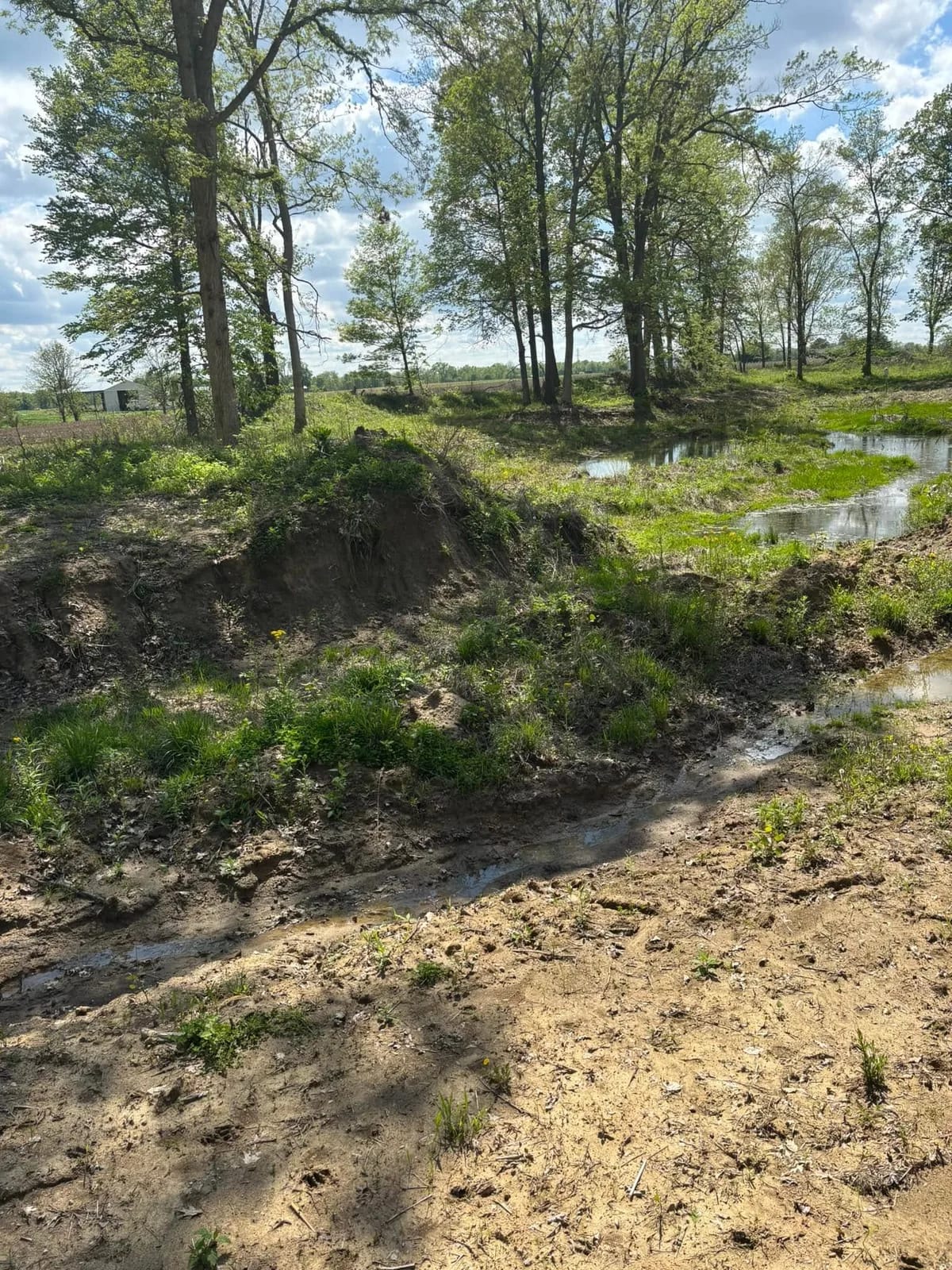
Why K&H
Why Pond Owners Choose K&H Excavating for a Full Cleanout
A full cleanout is mostly a judgment call made one bucket at a time: when to stop digging, what goes where, and how to keep the clay intact. That's why it matters who's doing it.
Kory quotes the cleanout and then sits in the seat deciding, bucket by bucket, where the muck ends and the clay begins.
A drained pond bottom will swallow light equipment. K&H digs and loads with excavators and pushes and spreads with dozers.
When the sediment can't stay on your ground, K&H loads it and hauls it off with its own trucks, so there's no waiting on a hired hauler while the bottom dries out.
Kory's family has farmed in Parke County, so he looks uphill as well as down. He'll show you the gully, tile outlet, or bare field edge that filled the pond and what would slow it next time. Read about Kory and how K&H works.
How it works
How Our Pond Sediment Removal Works
Step 1 — Probe the Pond With Kory
Kory walks the banks, checks how deep the soft layer runs, and looks for a drain pipe, a firm truck route, and a place for the spoil. He'll say plainly whether a full cleanout is worth it or a smaller inlet job will do, then put the price in writing.
Step 2 — Locates, Permit Check, and Drawdown
Before the first bucket, Kory calls in an Indiana 811 locate, which state law requires two full working days ahead. A floodway pond or spoil site, or an acre or more of disturbed ground, can trigger a permit. Kory will tell you on the walk-through what's likely needed, so the landowner or permit holder can file it now rather than mid-job. Then the water comes down and the fish plan goes into action.
Step 3 — Let It Firm, Then Dig to Clay
The exposed bottom sits until it will carry equipment. The excavator digs to the original clay and loads trucks while the dozer moves firmed silt, and soupy muck gets spread thin to drain. Questions mid-job? A text to Kory is the quickest way to get an answer.
Step 4 — Place the Spoil and Reshape the Basin
Silt goes to the agreed upland spot, out of the floodplain, or onto K&H's trucks. Kory re-cuts the edges, deepens the middle where the clay allows, and grades and seeds the spoil area. Clemson recommends getting bare ground vegetated within two weeks.
Step 5 — The Final Walk-Around with Kory
Before the refill, you walk the empty basin with Kory: the clay bottom, the new edges, the spoil area, and the inlet that started it all. Restoring pond depth is half the result. Knowing what will keep it deep is the other half.
How we quote
How Much Does Pond Sediment Removal Cost in West Central Indiana?
Each cleanout is quoted per job after Kory has probed the pond, because the price follows volume. Clemson Extension names the amount of sediment as a principal factor in dredging cost. Run the arithmetic on a 1-acre pond that has lost three feet: 3 acre-feet times 43,560 cubic feet, divided by 27, is roughly 4,840 cubic yards of fill to dig, load, and place. Kory turns that volume, plus the drawdown and spoil plan, into a written number. The pond dredging cost guide goes deeper into the math.
K&H takes cash, check, and credit card, and Kory can go over payment when he gives you the number.
What changes the price
- Cubic yards of sediment: depth of fill times the area it covers.
- How much is muck. Organic muck needs drying time and more spoil space than firm silt.
- Drawdown. A working drain valve costs less than pumping.
- Access. A firm haul path versus soft bottoms, timber, and fences in the way.
- Spoil. Spreading on your ground versus loading and hauling off, and how far.
- Resealing thin spots or reshaping the edges.
Quoted separately
- Digging deeper or wider than the original basin (pond excavation and enlargement)
- Fish salvage, restocking, and aeration, which aren't part of the cleanout price
- Engineering or permit fees, if the job requires them; any permit is filed by the landowner or permit holder
Related work
Often Paired With Pond Sediment Removal
An empty pond is the best time to deal with what comes next.
Pond Dredging Services
Not every pond can be drained. If yours has no drain pipe or has to keep holding water for livestock, a bank-side dig that leaves the water in may be the better route. See pond dredging services and methods for how the approaches compare.
Pond Silt Removal
After a full cleanout, the inlet is where new silt shows up first. A small dig at the creek mouth whenever the fan starts building again keeps it from spreading back across the bottom. See pond silt removal at the inlet.
Pond Excavation & Enlargement
With the pond already drained and the machines on site, adding depth or surface area is usually simpler than bringing the machines back for a separate job later. See adding depth or acreage to an existing pond.
More in Pond Dredging: Pond Dredging · Pond Dredging Services · Pond Dredging Cost Guide
Where we work
Pond Sediment Removal Across the Wabash Valley and West Central Indiana
From Rosedale, on the south edge of Parke County, K&H handles cleanouts within about 50 miles as everyday work and travels up to about 75 miles for larger basins, including across the state line into eastern Illinois. Counties inside that core include Parke, Vigo, Clay, Vermillion, Putnam, Owen, and Sullivan. Ground varies across that footprint. Wind-blown silt (loess) covers about 44% of Vigo County and 35% of Clay County by IGWS mapping, strip-mine ground runs through both, and limestone takes over around Bloomington.
To the southeast, equipment heads out on county roads to IN-59 at Brazil and picks up IN-46 through Spencer toward Bloomington and the Lake Monroe country. US-41 runs south into Terre Haute and north past Rockville toward Turkey Run State Park, where IN-47 heads east to Crawfordsville. For Lafayette, US-41 north meets I-74 at Veedersburg and IN-25 finishes the trip. US-36 carries equipment east through Danville toward Indianapolis.
Need pond sediment removal near Bloomington or Indianapolis? We serve Rosedale, Terre Haute, Bloomington, Lafayette, and Indianapolis. See all of K&H's excavation services.
Wondering if your pond is close enough? Call or text Kory at (765) 548-3704.
Questions
Pond Sediment Removal FAQ
How much does pond sediment removal cost?
It depends mostly on how many cubic yards come out and where they go. Every acre-foot of fill works out to roughly 1,613 cubic yards (43,560 cubic feet divided by 27), so depth and area add up fast. Kory gives you a written number after probing the pond. Our pond dredging cost guide covers the drivers.
Do you have to drain the pond?
For a full-basin cleanout, yes, or at least draw it down far enough that the bottom firms up and can be dug dry. That's what lets the excavator reach the original clay. If your pond can't be lowered, see the bank-side options on our pond dredging services page.
What's the difference between pond muck and silt?
Muck is the dark, soft layer of rotted leaves, algae, and plants, with roughly 20% to over 80% organic content per University of Florida IFAS. Silt is fine mineral soil washed off fields and banks. In pond muck removal, the organic layer stays wet and needs drying time, while mineral silt firms up and can often be reused on your ground.
Will removing sediment from a pond make it leak?
It shouldn't if the digging stops at the original clay, and working dry is what lets you see the layers. Kory stops when the bucket reaches the clay the pond was built on, and any thin spot gets a compacted clay seal before the refill. Seepage is ultimately up to the ground under the pond, so K&H won't guarantee a pond is leak-proof, but those steps protect the seal it already has.
Where does all the sediment go?
Upland and out of the floodplain, either spread and seeded on your property or loaded and hauled away. Spoil hauled on our own trucks means no waiting on a hired hauler to clear the site. Kory picks the spoil spot with you on the first walk.
What happens to my fish?
A full drawdown leaves little room for fish, so settle how you'll handle them before the water drops. Many owners restock once the pond refills. Purdue and Indiana DNR both call for at least five feet of water for fish to overwinter, so a deeper basin gives a restocked pond a better start.
How long does a pond cleanout take, and when is the best time?
Summer and fall are best, since the bottom dries faster and fall and winter rain refill the pond. Spring brings the heaviest rain of the year here, which can keep a drained bottom from ever drying out. Kory can give you a realistic schedule once he's seen how much fill there is and how fast the bottom is likely to dry. And with Kory on every job, you deal with one person from the first probe to the refill.
Can't I just use bacteria or an aerator instead of digging?
Not for a pond that's badly filled in. University of Florida IFAS reports little scientific evidence that bacterial treatments work on muck, and calls dredging the only approach that guarantees removing it. Aeration can help water quality, but it won't move silt. A pond that's shallow wall to wall needs digging, and that's work for excavators and dozers — no skid steers.
Ask Kory About My Pond
Still have a question about pond sediment removal? Call or text Kory at (765) 548-3704.
Call or text
Ask Kory about pond sediment removal
(765) 548-3704Calls and texts answered Monday to Saturday, 8 a.m. to 6 p.m. Text a few photos of the property and Kory can give you a head start before the site walk.
Get a free estimateFree estimate
Let's Dig Your Pond Back to Clay
Tell Kory how deep your pond used to be, and he'll come probe the bottom, show you where the clay starts, and give you a straight number for getting it back. Use our contact page to send the details, or call or text him.