Ponds and lakes
Yearly Stormwater Pond Maintenance in Rosedale, IN
Tired of finding out the basin was full only after the lake turned brown? A yearly plan puts regular eyes on your inlets and a machine in the basin before it overflows, not after.
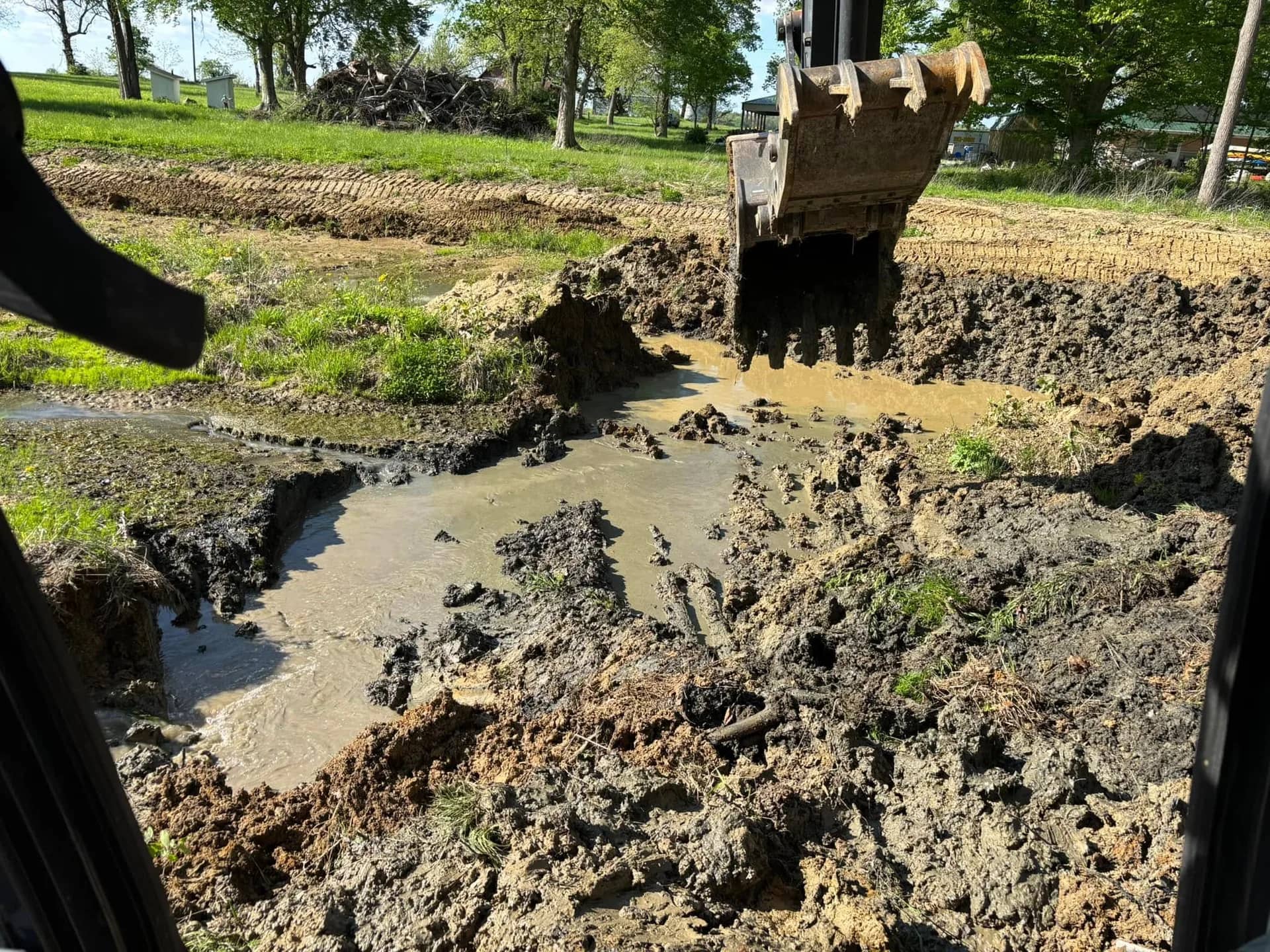
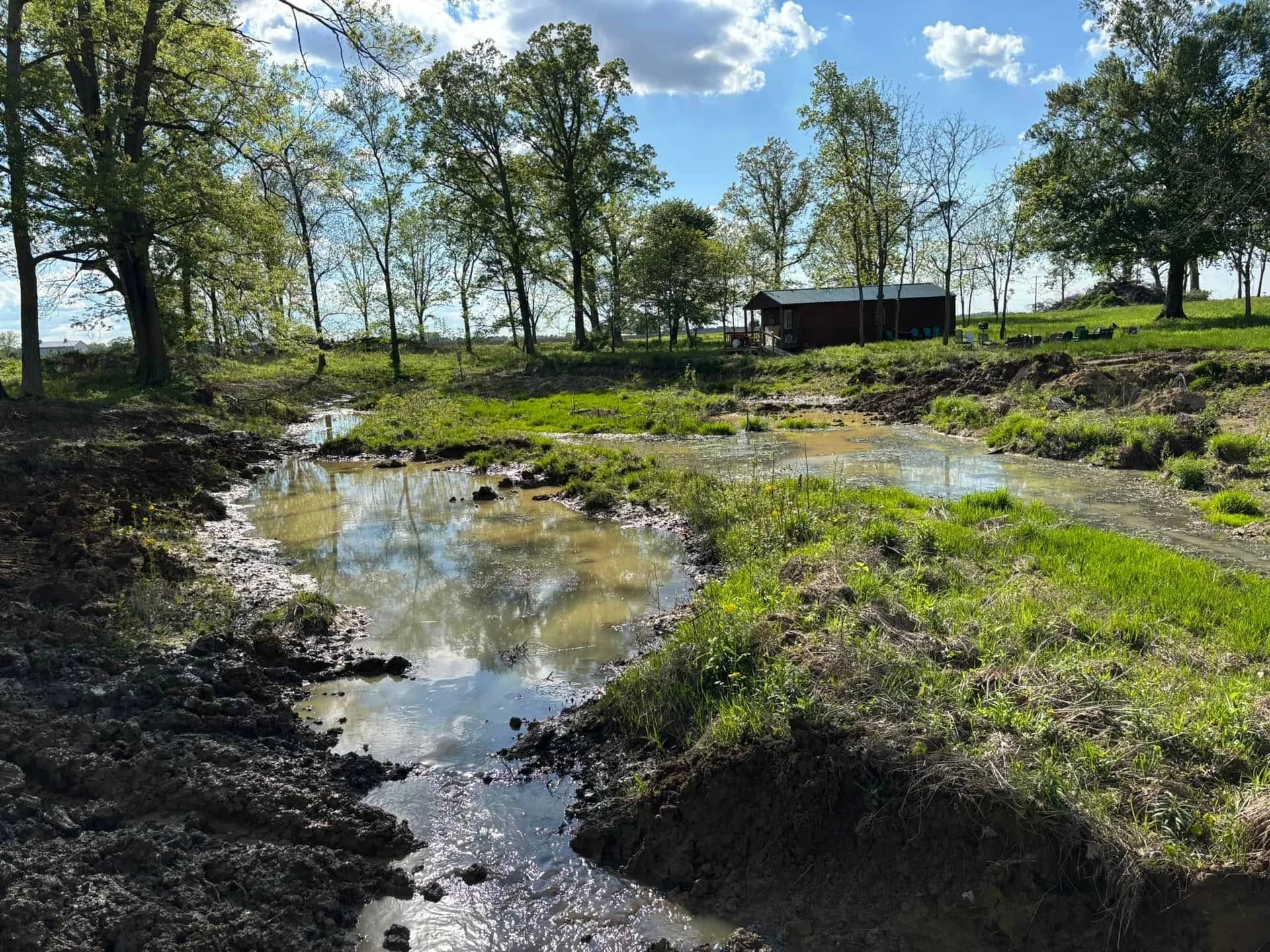
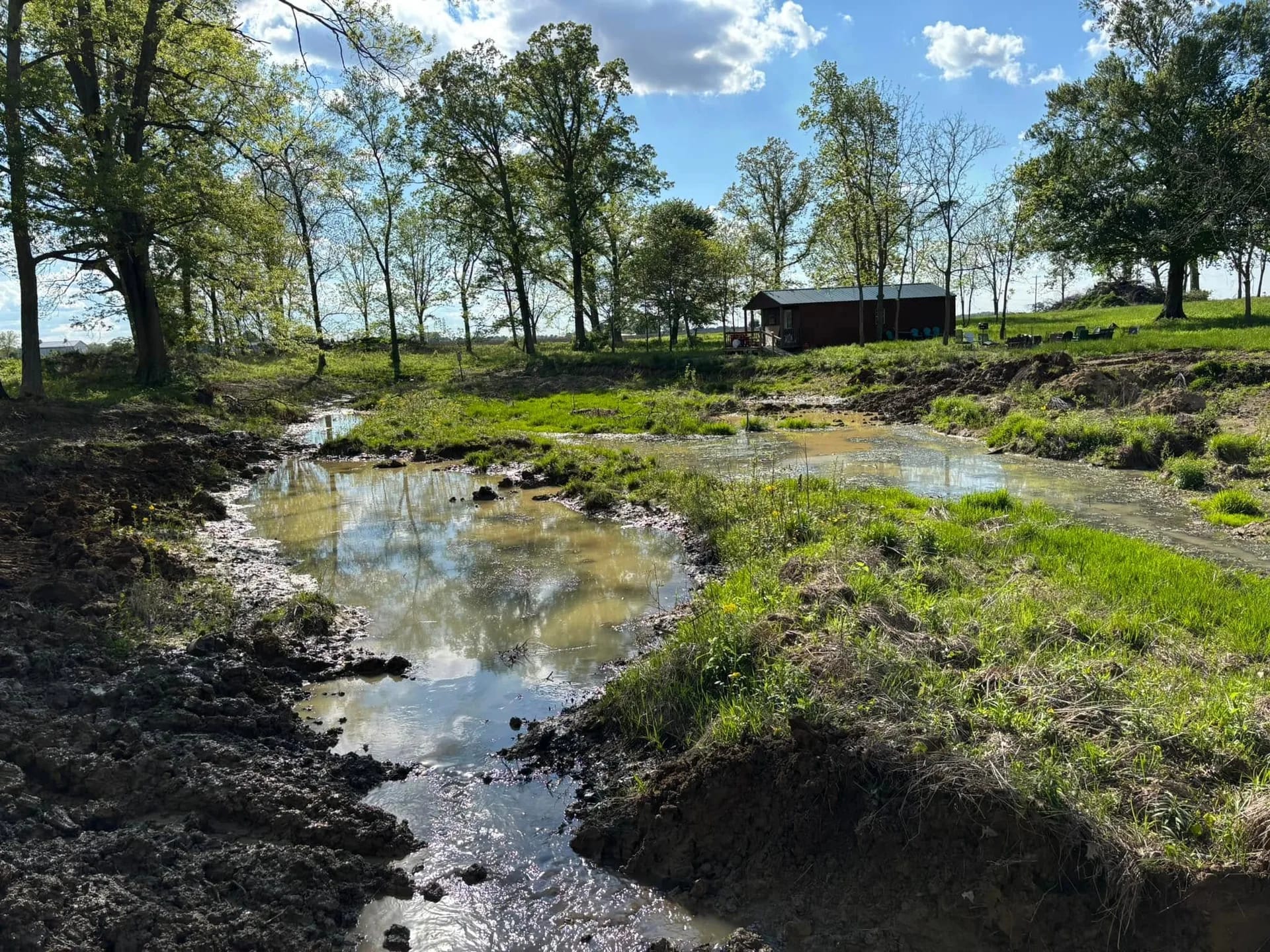
Most lakes and retention ponds get attention in emergencies: a blown inlet, a brown plume after a June storm, a cove nobody can float a kayak in. K&H Excavating sets up stormwater pond maintenance differently for lake associations, conservancy districts, HOAs, and commercial sites in west central Indiana: a yearly plan for each property, built around scheduled inspections of every silt pond and forebay plus planned dig-outs, so retention pond clean up happens on a calendar instead of in a panic. Kory sets the terms for each site after he's seen the basins. We're a Rosedale excavating company owned by Kory Stone, who comes from a Parke County farm family and runs the jobs himself. The plan sits under our silt pond maintenance service. Call or text Kory at (765) 548-3704 to talk through what your basins need.
When to call
Signs Your Basins Need a Plan, Not Another One-Off Call
Cleanouts done only when something breaks cost more, because by then the basin has been passing silt for months and the inlet has usually washed out too. A board that changes every year or a property manager juggling forty other tasks can't be expected to remember which forebay was dug when. A plan hands that memory to one person. These are the signs it's time:
- Nobody on the current board knows when the forebays were last cleaned.
- You've paid for two or more emergency cleanouts in the last few years.
- Upstream ground is changing: new rooftops, a parking lot, or fields going from hay to row crops.
- Your retention pond's outlet clogs with trash or brush after every big rain.
- Lake coves below the inlets keep getting shallower, even after a cleanout.
- Your insurer, lender, or local stormwater office has asked what maintenance the pond gets.
- You're taking over a pond from a developer, or the association is setting a multi-year budget.
What's included
What a Stormwater Pond Maintenance Plan Includes
A plan is a standing arrangement built around three jobs: inspecting every basin on a schedule, digging basins out before they pass silt, and keeping a record of depths over time. Kory sets the schedule, what's included, and the yearly fee for each site after he walks it.
Seasonal Inspections at Every Basin
Each visit, Kory checks sediment depth against the cleanout stake, the inlet channel and rock, the berm for slumps or burrows, and the outlet for trash and woody debris. A plan can include quarterly visits plus a look after big storms, with the exact schedule set for your property. The federal sediment-basin standard, NRCS 350, includes two upkeep items that matter most here: periodic inspection of the embankment and spillway, and prompt sediment removal once it hits a predetermined level. The plan turns those two lines into a schedule.
Scheduled Dig-Outs Before Basins Overflow
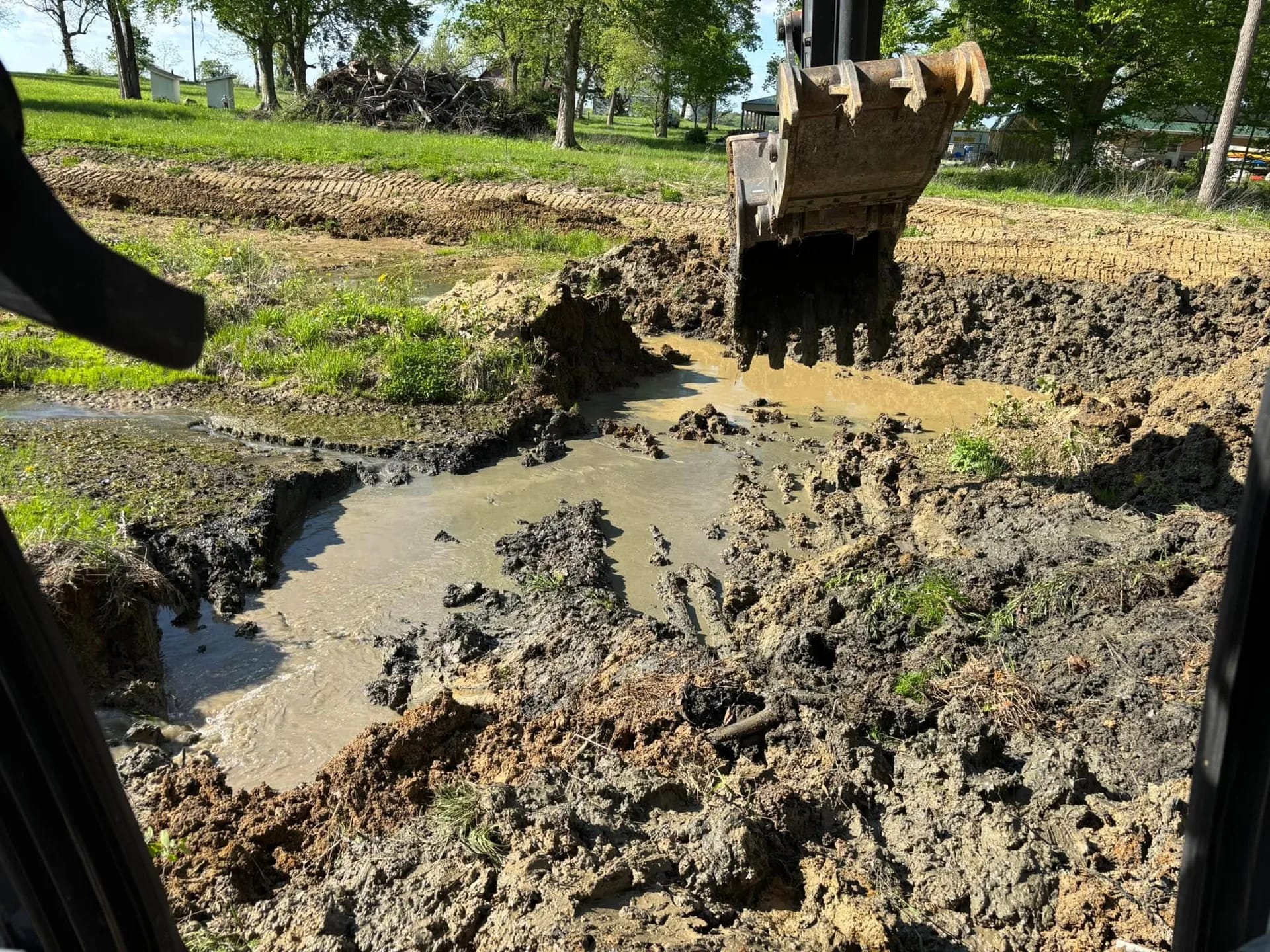
A plan can include one or two dig-outs a year, depending on how fast your basins fill, timed for when the ground will carry an excavator without rutting the berm. Kory digs each basin back to its original bottom, shapes the spoil with a dozer, and either spreads it upland or trucks it off. Basins that aren't near the halfway mark get skipped, and the cleanout moves to the one that needs it.
A Calendar Built Around Indiana Weather
March through May is the wettest stretch at Terre Haute, with April and May each averaging about 4.7 inches, so spring visits come right after the big rains, when basins fill. Summer brings low water and firm banks, the best window to dig. Fall is the second dig window and the last chance to empty basins before winter rain. Winter, when overnight lows average below freezing December through February, is for walking berms and taking trees off embankments while the ground is hard.
The Same Person at Every Visit, With a Written Record
Kory handles plan visits himself, so the person who saw your basins in April is the one judging them in October. A plan can also include a short write-up after each visit, with dated photos of each inlet, berm, and outlet, depth readings at the stake, and what he recommends next. Boards can file it with meeting minutes.
Local ground
The Retention Pond Problems We See Most in West Central Indiana
HOA retention ponds often pass from a developer to an association that never budgeted for them, and lake association boards turn over. Five years later, no one knows the basin's design depth. A plan keeps one baseline on file.
IDEM's Construction Stormwater General Permit covers sites disturbing an acre or more (IDEM construction stormwater permitting), and while the work is underway the permit requires a site evaluation by the end of the next business day after a half-inch rain in 24 hours, and at least once every work week. Once the job is finished and the permit ends, the pond downstream becomes the owner's problem, often already carrying a load of construction silt. A first pond silt removal visit resets it.
When a forebay overflows for a few seasons, the silt lands in the lake. Getting it out of open water is a lake sediment removal job, which takes more machine time and more spoil handling than digging the same silt out of the basin above it.
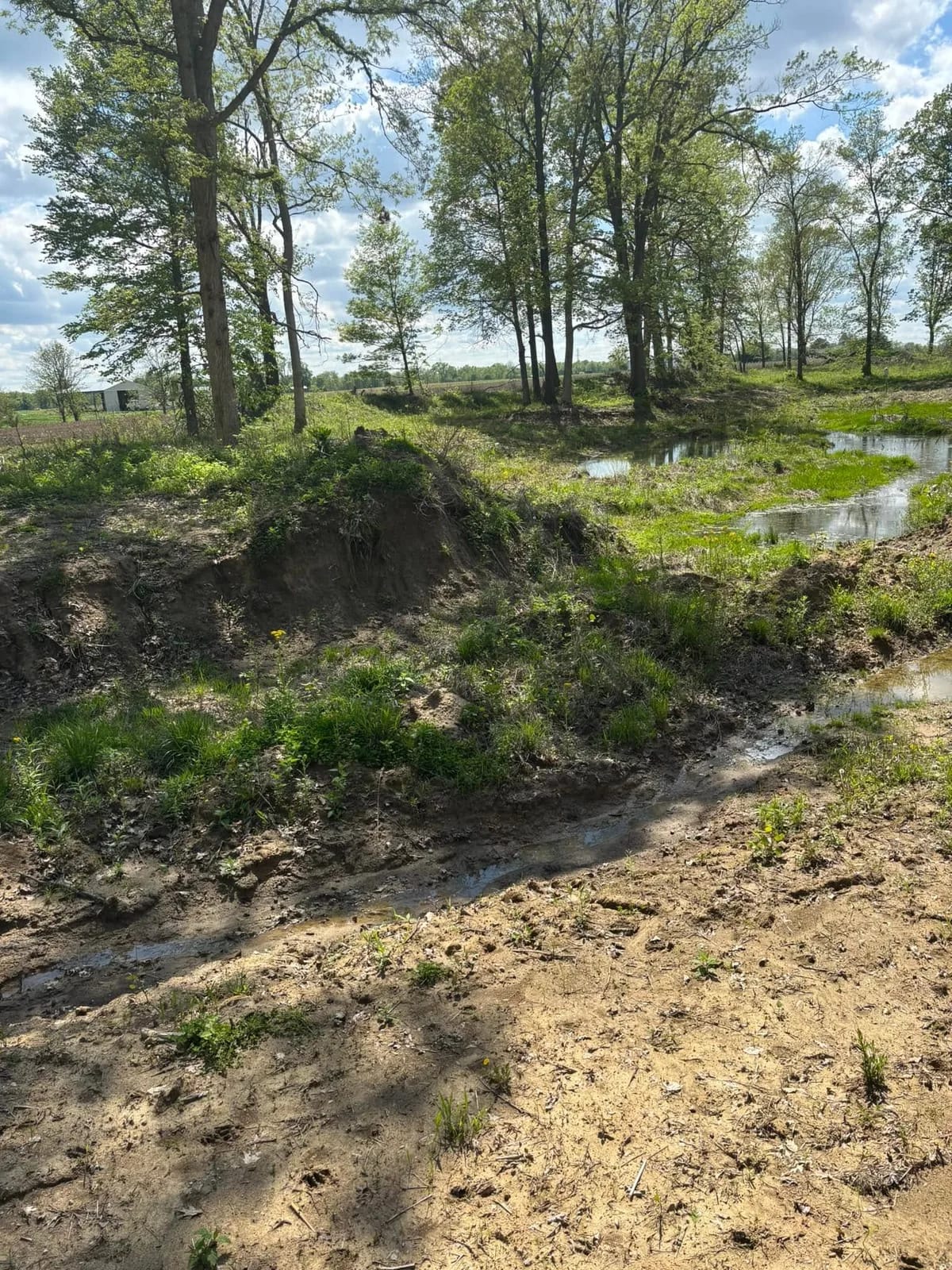
That same NRCS standard puts clearing trees and brush off the basin on its routine upkeep list (NRCS Sediment Basin Standard 350). Roots open seep paths, and a riser plugged with sticks pushes water over the emergency path every storm.
Why K&H
Why Lake Associations Choose K&H Over Other Retention Pond Maintenance Companies
Most retention pond maintenance companies sell fountain service, algae treatment, and mowing. K&H's plan covers the part that decides whether the pond stays a pond: the sediment and the earthwork.
You don't get a rotating cast. Kory inspects and digs himself, so your basins are judged against what he saw last season, not a stranger's first impression.
Kory walks every inlet, basin, and outlet on the property before he proposes a plan, at no charge, so the fee is based on your actual basins and not a per-acre guess.
Calls and texts are answered Monday through Saturday, 8 a.m. to 6 p.m., and texts get answered after hours too. When a storm blows out an inlet on a Sunday evening, send Kory a photo and you'll know what happens next.
Kory's family has raised cattle and hay in Parke County, and he knows when a field will carry a machine and when it'll rut. Dig-outs are scheduled for firm banks, which protects your berms and lawns. Learn about Kory and how K&H works.
How it works
How a Stormwater Pond Maintenance Plan Works
Step 1 — Walk Every Basin With Kory
Kory meets your board, manager, or owner on site and walks each inlet, silt pond, forebay, and outlet. He asks what's been done before, who needs the reports, and what the lake or pond is used for. You get a written plan proposal with the visit schedule and the yearly fee he sets for your site.
Step 2 — Set Baselines and Cleanout Triggers
On the first visit, Kory records the starting sediment depth in each basin and the halfway mark that will trigger a cleanout. If a basin is already past that mark, he'll recommend a one-time catch-up dig-out before the plan starts.
Step 3 — Seasonal Visits and Storm Checks
Visits can follow the calendar: after spring rains, in summer, in fall, and in winter for berm and tree work. The timing is tailored to your basins, and you hear from Kory after each visit about what he found.
Step 4 — Scheduled Dig-Outs
When a basin hits the stake, Kory books the dig-out for the next firm-ground window, places the Indiana 811 locate at least two full working days ahead, and takes it down to the original bottom. If the dig might need an IDNR floodway or lake permit, he flags it first, and the owner or association files.
Step 5 — The Final Walk-Around with Kory and a Year-End Review
After each dig-out you walk the basin with Kory. At the end of the plan year, a review with Kory can cover depths over time, what was removed, and what to budget for next year.
How we quote
How Much Does Retention Pond Maintenance Cost in West Central Indiana?
A plan is built around one yearly fee for the inspections and dig-outs it covers, and the amount comes from Kory's walk of your property. Extra cleanouts beyond the plan, or a first catch-up cleanout on a neglected basin, are quoted on their own. Plan options to set with Kory: Depending on how fast your basins fill, a plan can be built around any of these: Inspections only, with dig-outs quoted as needed; Inspections plus one dig-out a year; Inspections plus two dig-outs a year, for basins below construction or row-crop ground. Contract length, cancellation notice, and how a storm-filled basin is handled between visits get worked out property by property.
K&H takes cash, check, and credit card. Payment options are worth raising with Kory while he puts the plan together.
What changes the price
- Number of basins and how far apart they are on the property.
- Size. For 1 acre pond maintenance, the arithmetic is simple: one foot of silt over an acre works out to 43,560 cubic feet, roughly 1,613 cubic yards.
- Watershed load. Basins below active construction or bare cropland fill faster and need more dig-outs.
- Access to the berm and the spoil area, including lawns, fences, and soft ground.
- Spoil spread on site versus trucked off.
- Distance from Rosedale.
Quoted separately
- First catch-up cleanout of a basin already past the halfway mark (pond silt removal)
- Silt already in the lake (lake sediment removal)
- Fountains, aeration, algae and weed treatment, and mowing
Related work
Often Paired With Stormwater Pond Maintenance
A plan keeps basins working. These handle what built up before the plan started.
Pond Silt Removal
Most basins coming onto a plan haven't been touched in years and have a delta at the inlet. A one-time dig back to design depth gives the plan a clean starting point. See catch-up pond silt removal before a plan starts.
Lake Sediment Removal
If the forebays overflowed for a few seasons, the coves below them have caught the rest. Targeted removal at coves and inlet deltas brings those spots back. See lake sediment removal for coves and inlets.
Pond Dredging
Some HOA and commercial ponds have no forebay at all, and the whole pond is the silt trap. Once it's shallow, it needs a full cleanout before a plan can protect it. See pond dredging with excavators.
More in Silt Pond Maintenance: Silt Pond Maintenance · Pond Silt Removal
Where we work
Stormwater Pond Maintenance Across the Wabash Valley, West Central Indiana, and Eastern Illinois
K&H runs plans from Rosedale, in Parke County, within about 50 miles as a matter of course and up to about 75 miles for properties with several basins. For HOA and commercial ponds on the west side of Indianapolis, the route is US-41 north to Rockville and US-36 east through Bainbridge and Danville, roughly 70 miles of driving. Lafayette is US-41 north past Rockville, IN-47 east past Turkey Run to Crawfordsville, then US-231 north. Terre Haute is the short run: south on Rosedale Road into the east side near Deming Park, or US-41 south about 16 miles. Across the Wabash, IN-163 runs west through Clinton toward the Illinois line.
Ponds differ along those routes. Around Indianapolis and Lafayette, flat glacial till plain makes up most of Hendricks, Marion, and Tippecanoe counties, and retention ponds there catch runoff from roofs, streets, and parking lots. Closer to home in Parke, Vigo, and Clay counties, the basins sit below cropland, loess, and old strip-mine ground. Farther out, the conservancy-district lakes of Putnam, Montgomery, and Hendricks counties sit inside the 75-mile range.
Looking for stormwater pond maintenance in Indianapolis or a retention pond plan near Terre Haute? We serve Rosedale, Terre Haute, Bloomington, Lafayette, and Indianapolis. See all of K&H's excavation services.
Want to know if your property fits a plan? Call or text Kory at (765) 548-3704.
Other services from K&H
Questions
Silt Pond Maintenance Plans FAQ
What does a stormwater pond maintenance plan include?
A plan can include seasonal inspections of every basin, one or two scheduled dig-outs a year, inlet and berm touch-ups, and a written record of photos and depth readings after each visit. Fountains, algae treatment, and mowing aren't part of it. Kory sets the visit count, the number of dig-outs, and the rest of the terms for each property after the walk-through.
How often does retention pond clean up need to happen?
It depends on how much ground drains to the pond and what's on it. IDEM's stormwater manual says to clean a construction-site sediment basin when it's half full, and University of Kentucky detention-basin guidance figures a forebay needs cleaning roughly once every five years. Basins below active construction or bare row-crop ground can need it every year. Seasonal inspections tell you which kind of basin you have.
What does 1 acre pond maintenance look like on a plan?
For a one-acre retention pond with a forebay, a plan can be built around checking the forebay each season and digging it out when it reaches the halfway mark, so the main pond stays deep. As arithmetic, every foot of silt that settles across a full acre is about 1,613 cubic yards. That's the volume a forebay is there to intercept before it spreads across the main pond.
Is there a contract, and can we cancel?
Contract length, cancellation notice, and how unused visits are handled are set per site, because no two properties fill at the same rate. Kory spells those terms out in the plan proposal so your board can review them before signing.
Will the same person look at our ponds every time?
Yes. Owner Kory on every job is how the plan is built: the person who set your baselines is the one comparing them each season. That continuity is the point of the plan: changes in a basin are easy to miss if a different person looks every time.
What if a big storm fills a basin between visits?
Text Kory a photo. Texts answered after hours means you aren't waiting for Monday to find out what happens next. Whether a storm-triggered visit or extra dig-out is covered or billed separately is something you agree on before the plan starts.
Does K&H handle permits or stormwater paperwork?
K&H doesn't hold or file permits for owners. Kory will tell you if a dig-out could fall under an IDNR floodway or lake permit and what's likely needed, and the owner or association files. Active construction sites stay under their own IDEM permit and inspection schedule.
Ask Kory About a Maintenance Plan
Still have a question about stormwater pond maintenance? Call or text Kory at (765) 548-3704.
Call or text
Ask Kory about silt pond maintenance plans
(765) 548-3704Calls and texts answered Monday to Saturday, 8 a.m. to 6 p.m. Text a few photos of the property and Kory can give you a head start before the site walk.
Get a free estimateFree estimate
Let's Put Your Basins on a Schedule Instead of a Crisis
Tell Kory what your property has, from one HOA pond to a dozen lake inlets, and who should hear from him after each visit. He'll walk them, set baselines, and propose a plan your board can vote on. Reach him through our contact page, or call or text directly.