
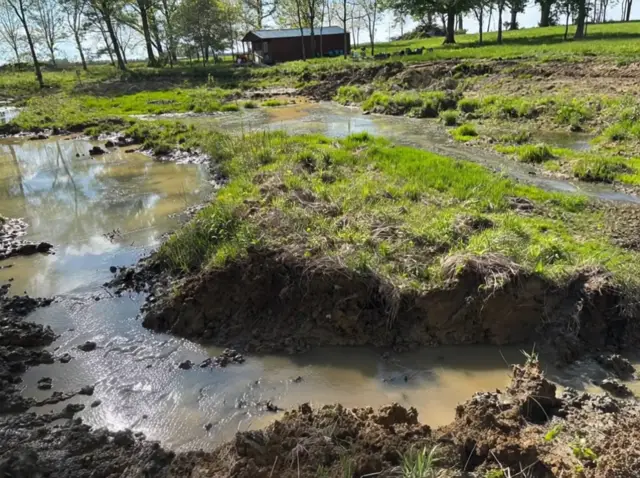
Ponds and lakes
Pond Dredging Services in Rosedale, IN
Shallow end gone to cattails? Muck where the bass used to hold? How the silt comes out decides the price, the mess, and how much depth you get back.
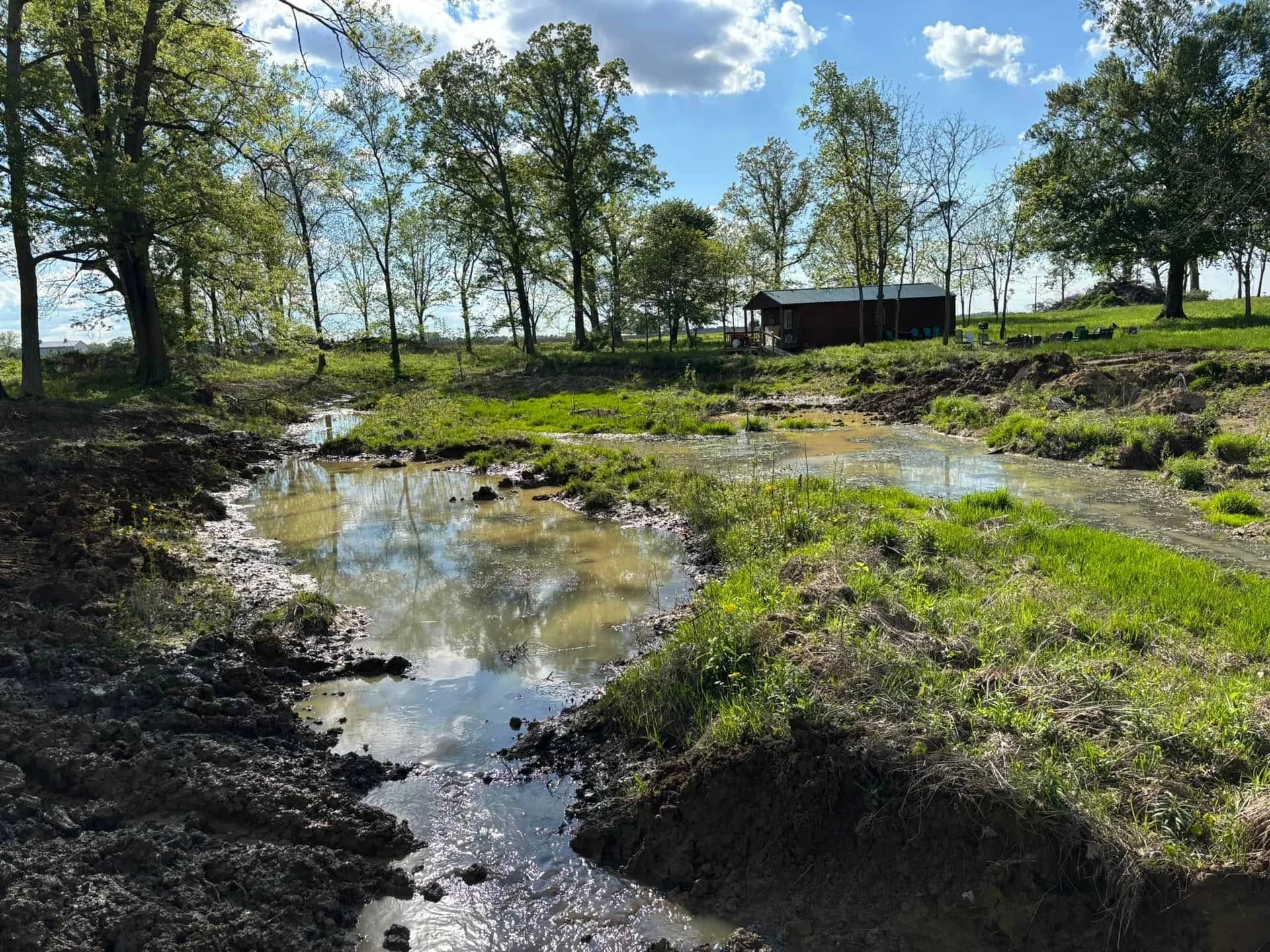
K&H Excavating provides pond dredging services for farm, stock, and fishing ponds across west central Indiana, and we do it mechanically, with excavators and dozers that dig the silt out and put it where it can stay. We're a Rosedale excavating company run by Kory Stone, based in Parke County less than a mile south of Big Raccoon Creek. Before a machine comes off the trailer, Kory looks at three things that pick the method: whether your pond can be drawn down, how far the deep silt sits from the bank, and where the spoil can go. Most ponds come out best dug dry; some get dug wet from the bank. A few are better served by a hydraulic dredge, which K&H doesn't run, and Kory will tell you that on the walk-through. Call or text Kory at (765) 548-3704 to set up a look at your pond.
When to call
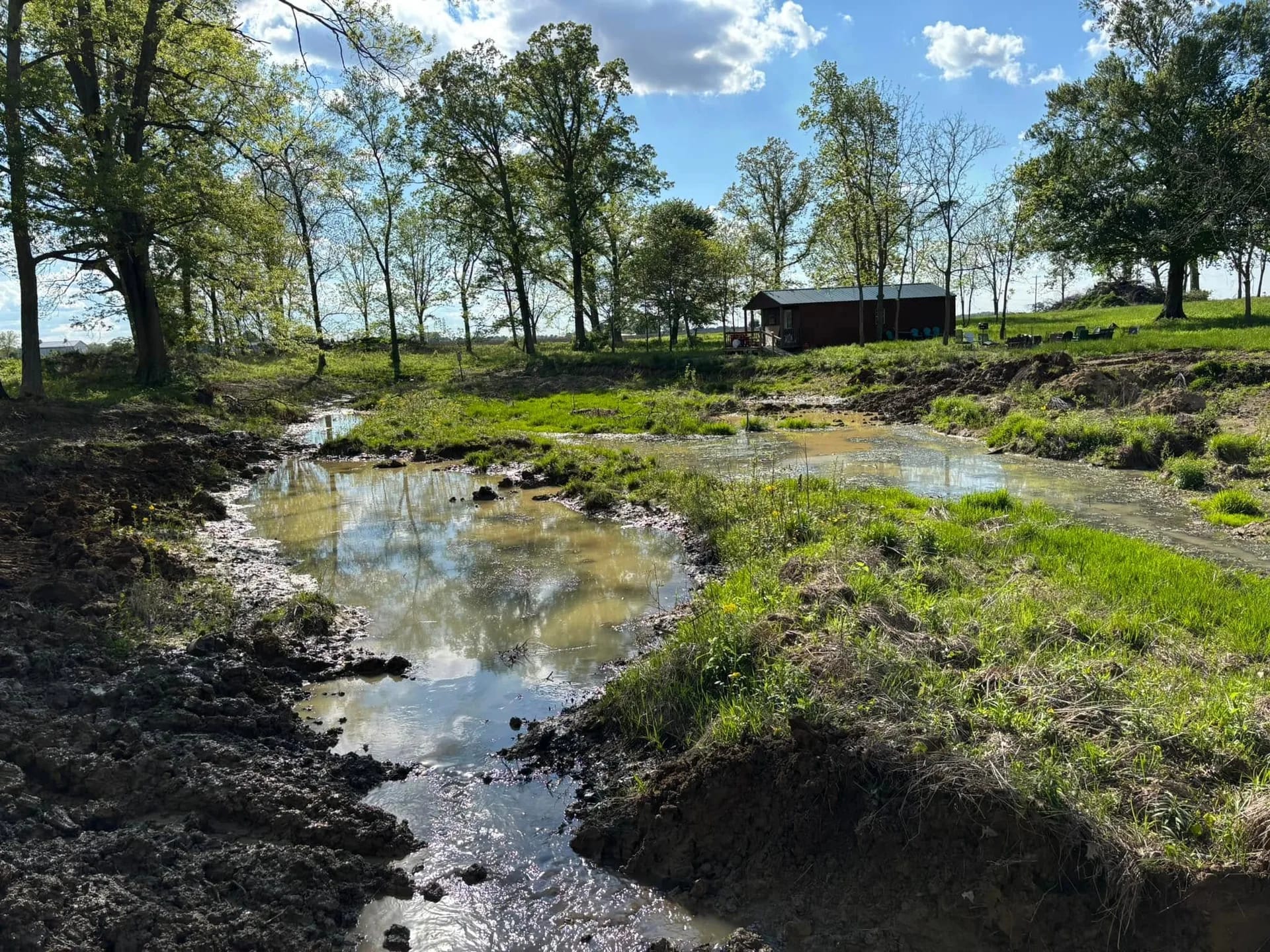
When a Silted-In Pond Can't Wait Another Season
Every hard rain carries a little more of the watershed into your pond. Clemson Extension notes that as ponds get shallower, plant and algae growth climbs with them. Waiting narrows your options, too. A pond with a couple of feet of soft silt along one end can often be cleaned from the bank. Let it go another ten years and the deep silt may sit past any machine's reach from shore.
- The shallow end has turned to cattails and mud you could almost walk across.
- A fan of silt is spreading out from where the creek or field ditch comes in.
- The water stays brown for days after a rain, and algae shows up earlier every summer.
- Cattle wade through muck to reach water, or the dock now sits on mud by August.
- Fish are fewer and smaller, or you've found some floating after a hot spell.
- You're selling the farm, building a house that looks out over the pond, or hosting a family reunion on the bank next summer.
What's included
What Our Pond Dredging Services Include
Dredging means taking settled silt and muck off the bottom and returning the pond to a useful depth, and the best way to dredge a pond is whichever of these three methods fits your water, your banks, and your ground.
Dry Dredging: Draw It Down, Then Dig
This is K&H's first choice whenever a pond can be lowered. The water comes down through the drain valve if your pond has one, or by pumping, and the exposed silt is left to dry. Clemson Extension notes that lowering the water lets sediment dewater naturally before removal. Once the bottom will carry a machine, the excavator digs down to the firm original clay and loads trucks or piles spoil for the dozer. Digging dry lets Kory see the old bottom and reshape the edges.
Wet Dredging: Digging From the Bank
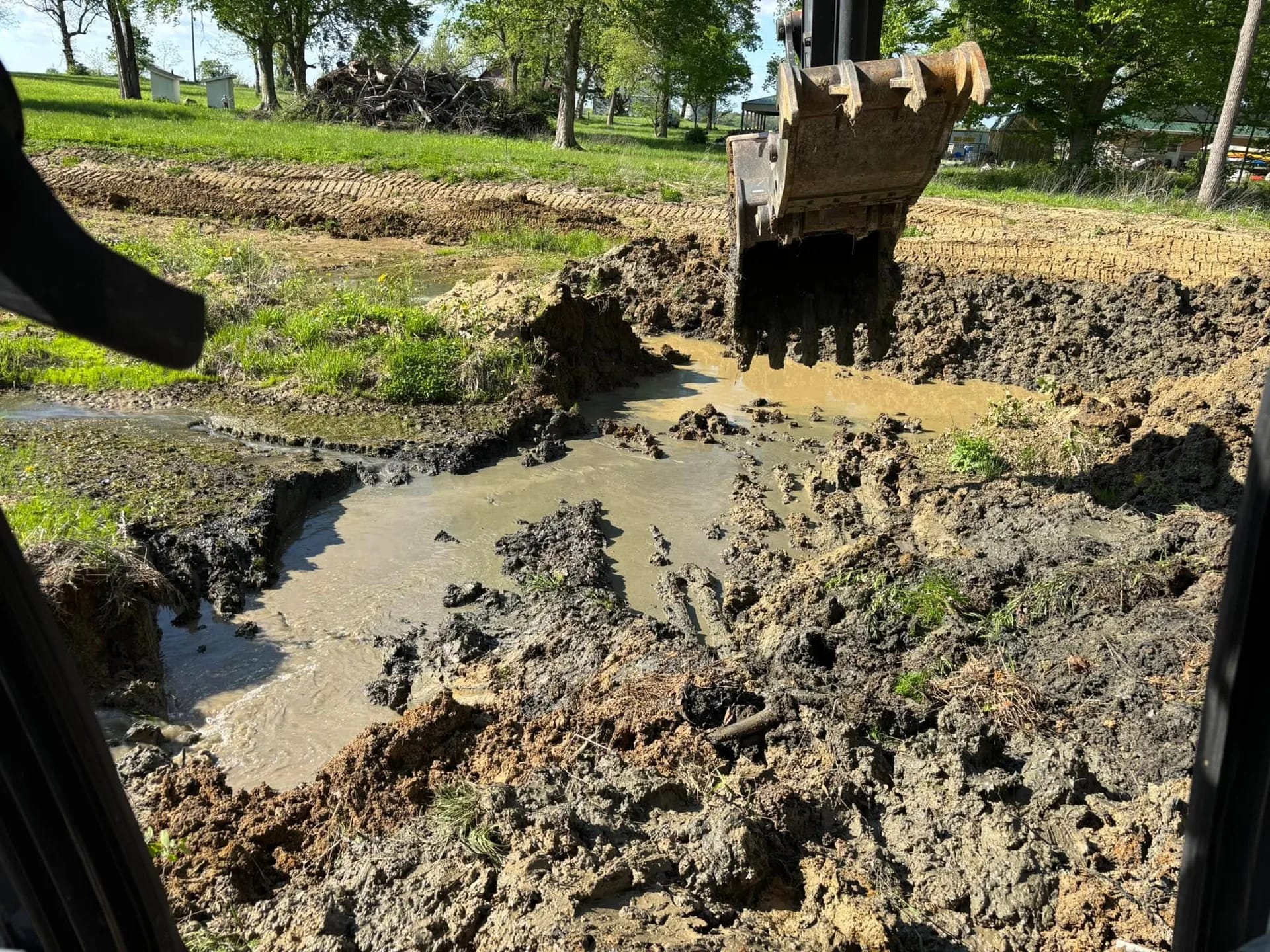
When a pond is spring-fed, has no drain, or waters cattle that can't go without, the excavator works from the bank instead. Kentucky's Energy and Environment Cabinet recommends exactly that for ponds: equipment that can scoop or lift material out from the bank. A standard excavator cleans the band near shore. When the silt sits farther out, a long-reach excavator can be used when the job calls for one; per manufacturer specs, those reach roughly 50 to 65 feet, which covers more of a small pond. Wet spoil is soupy, so it goes into a bermed drying area before it's spread.
Hydraulic Pond Dredging: When It's the Better Call
Hydraulic pond dredging pumps silt and water through a temporary pipeline to a settling basin or geotextile tubes. K&H doesn't run a hydraulic dredge. A suction dredge usually makes more sense when the pond is too wide for a machine on the bank to reach the middle, when the water has to stay up, when lawns or homes crowd the shoreline and trucks can't get around it, or when spoil has to travel a long way to a disposal site. If that's your pond, Kory will say so up front.
Spoil Placement, Bank Shaping, and Seeding
Clemson says dredged sediment belongs on upland ground, with double silt fence around any stockpile and bare soil seeded within two weeks. Kentucky adds that it should stay out of the floodplain. On most farms the spoil is spread thin on a nearby field, used to build up a low spot, or hauled off on K&H's own trucks. Kory regrades the edges toward the 3:1 slope Purdue Extension recommends and seeds the ground he disturbed.
Local ground
The Dredging Problems We See Most in West Central Indiana
Wind-blown loess covers about 44% of Vigo County and 35% of Clay County, per Indiana Geological and Water Survey mapping. The silt that washes off those fields settles into a soft layer that won't hold an excavator until it dries. April and May are the wettest months at Terre Haute, about 4.7 inches each, so a pond drawn down in spring can refill before its bottom ever firms up. That's why K&H schedules dry dredging for summer and fall.
IDNR has mapped surface coal mines across roughly a tenth of Clay County and about 7% of Vigo. Ponds on that ground are often old pits with steep sides, and IDNR warns that mine spoil is "much looser than the original materials." Kory keeps the machine back from soft pit edges.
Indiana's LARE program says the source of sediment should be addressed before dredging starts. If a gully or bare field upstream feeds the pond, dredging alone buys only a few years. Clemson Extension's pond dredging guide covers both mechanical and hydraulic methods and where spoil should go. When the whole basin has filled, it's a job for full-basin pond sediment removal.
Mechanical methods still work on bigger water: a 2024 IDEM notice for Lake Holiday in Fountain County described plans for a barge-mounted excavator to remove about 6,900 cubic yards from a 14.2-acre cove. Larger water belongs with our lake dredging services for private lakes and associations.
Why K&H
Why Pond Owners Choose K&H Excavating
Plenty of outfits will quote a dredging job. Fewer will tell you which method your pond needs.
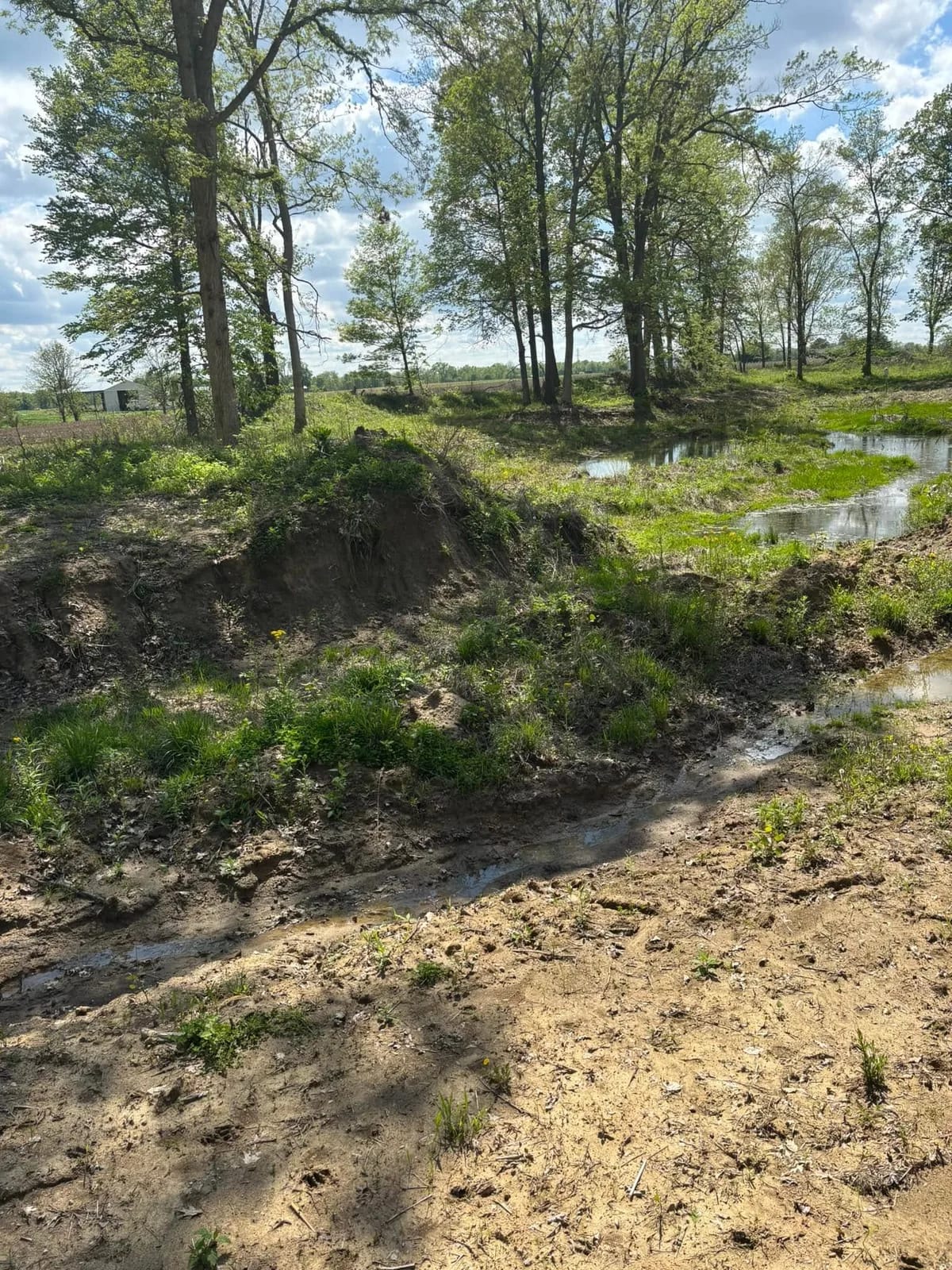
The person who walks your bank and recommends a method is the person running the excavator. Nobody in between forgets where your tile outlet is or which gate the cattle use.
Dredging takes reach and weight. K&H digs with excavators, spreads spoil with dozers, and hauls what can't stay on site with its own trucks.
If a hydraulic dredge would serve your pond better, you'll hear it from Kory before you sign anything, not after a machine sinks to its tracks in the middle of it.
Kory probes the silt, walks the access, and prices the job at no charge. Calls and texts are answered Monday through Saturday, 8 a.m. to 6 p.m., and texts after hours. Get to know Kory and how K&H works.
How it works
How Our Pond Dredging Services Work
Step 1 — Walk the Pond With Kory
Kory walks the shoreline with you and checks spots around the pond to find where firm clay starts under the silt. He notes the drain pipe if there is one, the inlet, where trucks can get in, and where spoil could go. He'll ask what you want back: fishing depth or stock water. A written estimate follows the walk-through.
Step 2 — Pick the Method and Plan the Spoil
Based on what the probe found, Kory recommends dry or wet digging, or tells you if a hydraulic dredge would fit better, and plans where the spoil goes. He places the Indiana 811 locate at least two full working days before digging. If the work could need a permit, Kory will tell you what's likely needed, and the landowner or permit holder files it.
Step 3 — Draw Down or Set Up on the Bank
For a dry job, the water comes down and the silt gets time to firm up. Drying time depends on the weather and the silt depth. For a wet job, Kory builds the drying area and puts up silt fence below any stockpile before the first bucket comes out.
Step 4 — Dig, Load, and Place the Spoil
The excavator digs to the original bottom, the dozer spreads and shapes the spoil, and trucks haul whatever has to leave. If you want to know how far down he's gotten, send Kory a text.
Step 5 — The Final Walk-Around with Kory
You walk the cleaned basin with Kory: the depth regained, the reshaped edges, and the seeded spoil ground. He'll also show you how to slow the next round of silt, such as the 66-foot grass filter strip NRCS recommends around Indiana ponds, according to Purdue Extension.
How we quote
How Much Do Pond Dredging Services Cost in West Central Indiana?
Every dredging job is priced after Kory walks and probes the pond, because volume drives the cost. Clemson Extension calls the amount of sediment to be removed a principal factor in what dredging costs. Our pond dredging cost guide walks through the cubic-yard math in detail.
Payment is cash, check, or credit card; bring any other payment questions up when Kory quotes your pond.
What changes the price
- Cubic yards of silt. One foot of silt over one acre works out to about 1,613 cubic yards (43,560 cubic feet ÷ 27, simple arithmetic).
- Method. Dry digging needs drawdown time; wet digging needs a drying area for the spoil.
- Reach. Silt in the middle of a wide pond is harder to get than silt along the bank.
- Access. Soft bottomland, timber, gates, and long hauls to the pond add machine time.
- Spoil. Spreading it on site costs less than trucking it away.
Quoted separately
- Silt removal at a single inlet or forebay, priced as its own job (pond silt removal at the inlet)
- Clearing brush and small trees off the banks for machine access (brush and underbrush clearing)
- Hydraulic dredging and geotextile tubes, which K&H doesn't offer
- Fish restocking, aeration, and docks, which sit outside the dredging job
Related work
Often Paired With Pond Dredging Services
These jobs come up next. If you're still deciding whether your pond needs dredging at all, start with our pond dredging overview.
Pond Sediment Removal
When silt has filled the whole basin rather than one end, the job becomes a full cleanout to restore the original depth. Kory will tell you on the walk-through how long yours is likely to take. See full-basin pond muck and sediment removal.
Lake Dredging Services
Lake associations and owners of private lakes face the same choice of methods at a bigger scale, with more permits and staging. See lake dredging services for private lakes.
Pond Dredging Cost Guide
Before you budget, rough out your own cubic yards with the acre-foot math and see what pushes a price up or down. See the pond dredging cost guide with worked examples.
More in Pond Dredging: Pond Dredging · Pond Sediment Removal · Pond Dredging Cost Guide
Where we work
Pond Dredging Services Across the Wabash Valley and West Central Indiana
K&H works out of Rosedale in southern Parke County, dredging ponds within about 50 miles routinely and up to about 75 miles, into eastern Illinois, for bigger jobs. Counties inside that core include Parke, Vigo, Clay, Vermillion, Putnam, Fountain, and Montgomery. From Rosedale, US-41 north meets IN-47 by Turkey Run State Park on the way to Crawfordsville, and continues to I-74 for Lafayette. US-36 heads east past Raccoon Lake through Bainbridge and Danville into Indianapolis. IN-163 crosses the Wabash at Clinton and runs to the Illinois line. To the south, county roads reach IN-59 at Brazil, and IN-46 carries on east through Spencer to Bloomington.
Parke County alone has 646 farms averaging 271 acres and about 8,400 head of cattle (USDA 2022 Census of Agriculture), and stock ponds on that ground take in field and pasture runoff every spring. Around Bloomington, the clay on a pond bottom sits over limestone with sinkholes, so Kory digs to the old bottom and no deeper.
Looking for pond dredging services near Terre Haute or Lafayette? We serve Rosedale, Terre Haute, Bloomington, Lafayette, and Indianapolis. See all of K&H's excavation services.
Not sure if your pond is in range? Call or text Kory at (765) 548-3704.
Questions
Pond Dredging Services FAQ
What's the best way to dredge a pond?
If the pond can be drawn down, digging it dry with an excavator gets at the old bottom and lets the edges be reshaped. If it can't come down and the silt sits within reach of the bank, digging wet from shore works. If the pond is too wide to reach or the water has to stay up, a hydraulic dredge may be the better tool. Kory sorts that out on a walk-through, and K&H offers free on-site estimates.
Do you offer hydraulic pond dredging?
No. K&H dredges mechanically, with excavators and dozers — no skid steers. Hydraulic pond dredging pumps silt through a pipeline to a settling area or geotextile tubes, and it can be the right call for wide ponds, ponds that must stay full, or shorelines with no room for trucks. If yours fits that description, Kory will tell you so.
Is dredging a pond by hand realistic?
For a small backyard water garden, a rake, a shovel, and buckets can work. For a farm pond, the math rules it out: a foot of silt across a quarter acre is about 400 cubic yards. Raking a weedy edge near a dock helps a little, but it won't bring back depth.
Do you have to drain my pond to dredge it?
Not always. A partial drawdown can expose the shallow end and the inlet delta while the deep water stays. IDNR's pond guidance describes draining in fall and letting spring runoff refill the pond. When the water can't come down at all, the excavator works wet from the bank.
Do I need a permit to dredge my pond?
It depends on the water. Federal Section 404 rules exempt the maintenance of farm and stock ponds from permits, unless the work puts the water to a new use and reduces the reach or flow of regulated waters. IDNR notes that many natural lakes count as public even without public access, and its private pond and lake management page says dredging those waters almost always requires a DNR permit. Work in a floodway can need one too. Kory will flag what likely applies on the walk-through.
How long does pond dredging take?
Machine time depends on acreage, silt depth, and method, and Kory can tell you what to expect once he's walked the pond. Dry jobs add drying time after the drawdown, which depends on the weather. Summer and fall are the best months, because spring rain can refill a drawn-down pond.
Who will actually be on my property?
Owner Kory on every job. He walks the pond, runs the excavator, and does the final walk-around with you. You won't meet him at the estimate and then hand your pond to strangers.
Ask Kory Which Method Fits My Pond
Still have a question about pond dredging services? Call or text Kory at (765) 548-3704.
Call or text
Ask Kory about pond dredging services
(765) 548-3704Calls and texts answered Monday to Saturday, 8 a.m. to 6 p.m. Text a few photos of the property and Kory can give you a head start before the site walk.
Get a free estimateFree estimate
Let's Put the Depth Back in Your Pond
Tell Kory where your pond is and what it's lost, and he'll come probe the silt, walk the access, and tell you straight which method fits and what it costs. Reach him through our contact page, or call or text directly.