
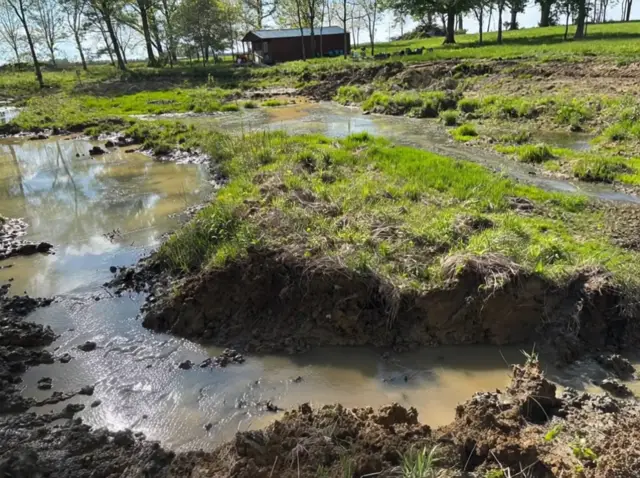
Ponds and lakes
Pond Dredging in Rosedale, IN
Can you see bottom three steps off the bank? Has the old swimming hole turned into a cattail flat? Your pond didn't shrink. It filled in, and it can be dug back out.
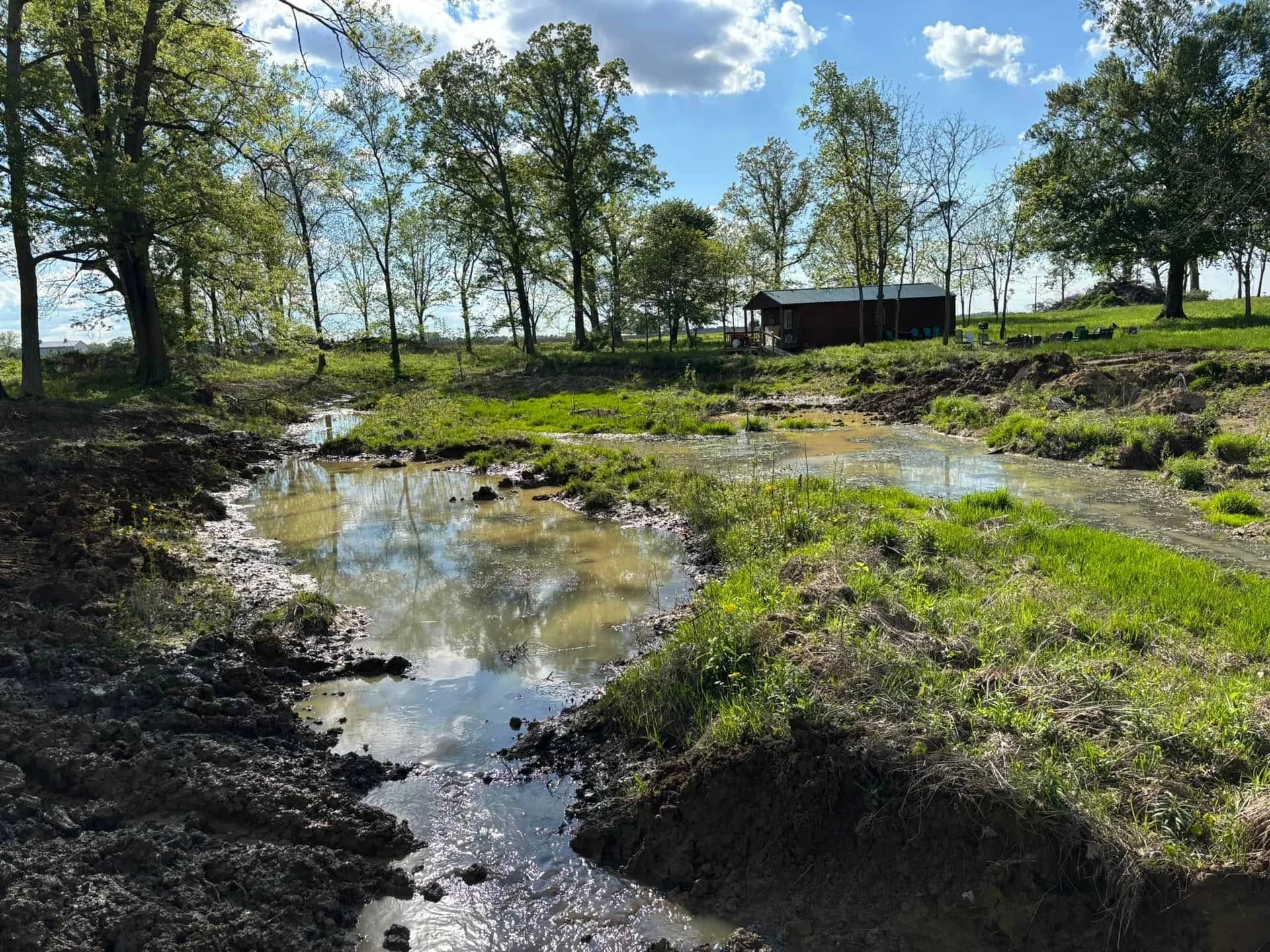
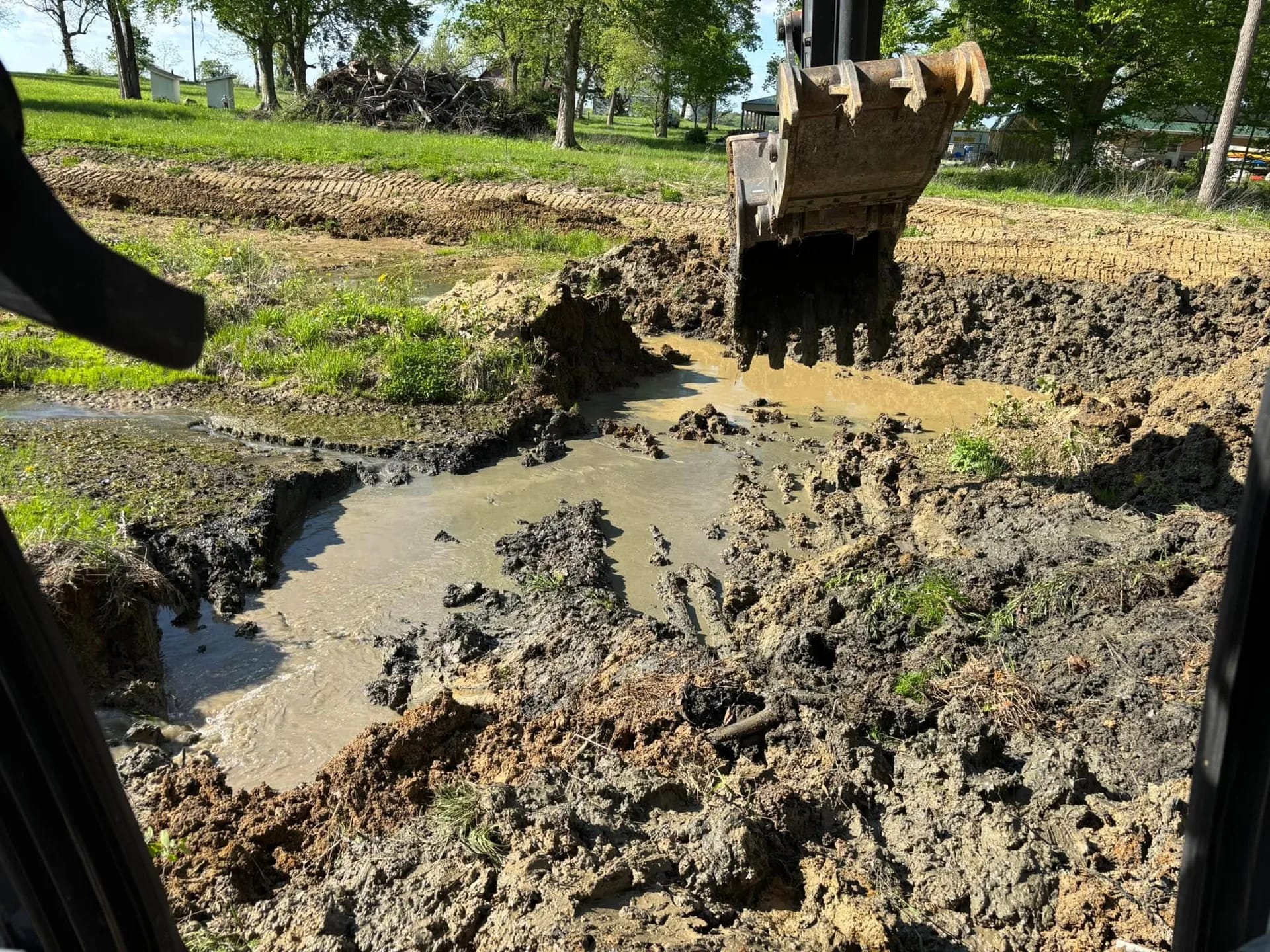
K&H Excavating handles pond dredging for farm, fishing, and lake-community ponds across west central Indiana, digging out the silt and muck that years of runoff have packed into the basin. We're a Parke County excavating company owned by Kory Stone and based in Rosedale, less than a mile south of Big Raccoon Creek, in the same creek-and-cropland country that fills most ponds around here. K&H dredges mechanically, with excavators and dozers, either after the pond is drawn down or from the bank with the water left in. Kory checks how much sediment is actually down there before he quotes, puts the spoil where it won't wash back in, and digs the depth back where fish and livestock need it. If your pond is getting shallower every summer, call or text Kory at (765) 548-3704.
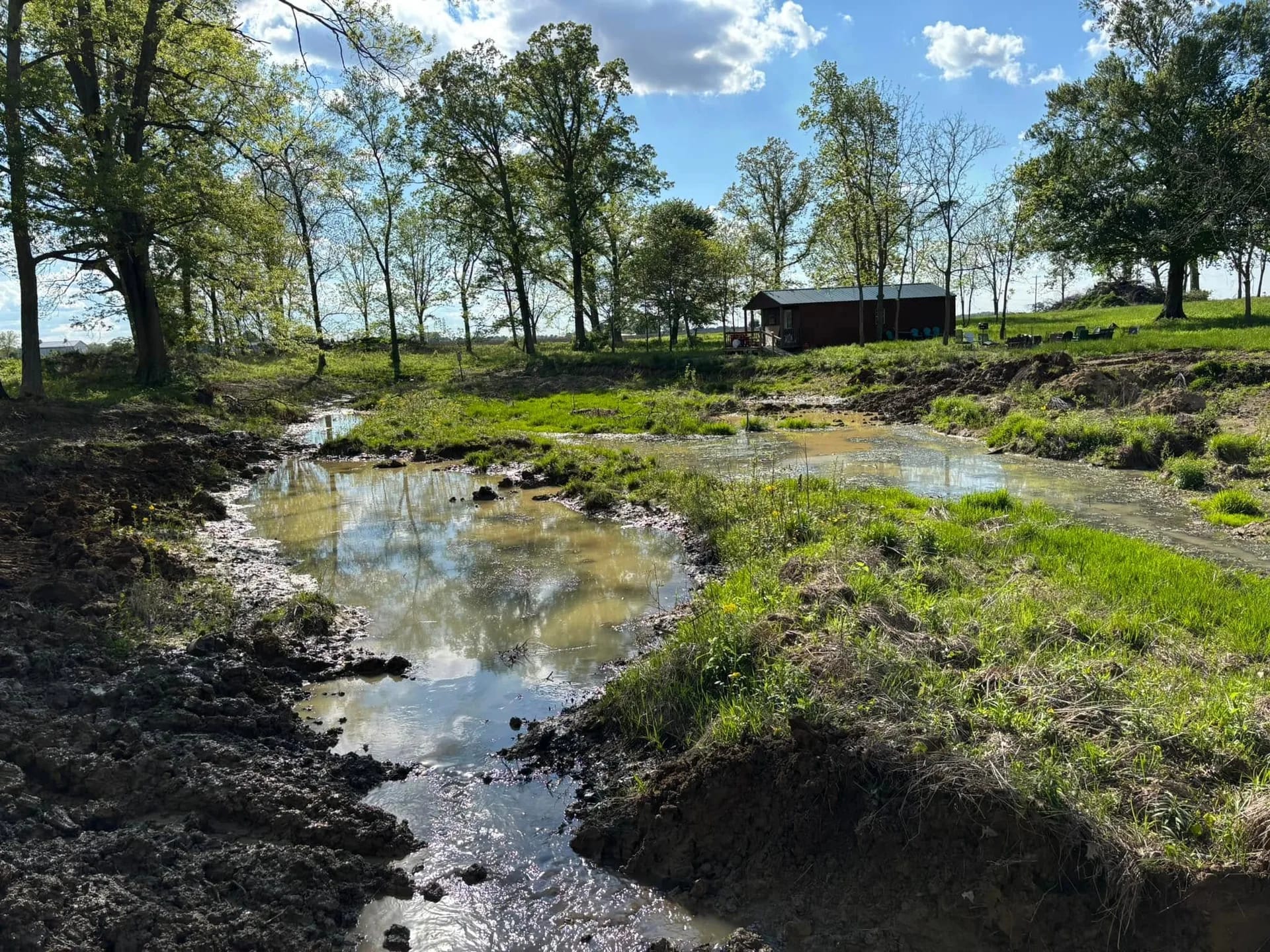
When to call
Why Ponds Fill In, and the Signs It's Time for Pond Dredging
Every pond works as a settling basin. Rain carries soil off fields, gullies, and bare banks, and when the water slows in the pond, the soil drops out. Leaves and dead algae add black organic muck on top. Purdue Extension tells Indiana pond builders to dig two extra feet just to hold that sediment. Once the cushion is used up, each new inch means warmer water, more weeds, and less room for fish. Waiting doesn't hold the price still, either: the longer a pond fills, the more cubic yards there are to move.
- You can see bottom well out from the bank, in water that used to be over your head.
- Cattails, lily pads, or moss have crept out across water that used to be open.
- A fan of silt has built out where the creek or tile outlet comes in (see pond silt removal at the inlet).
- The water stays brown for days after a rain, and the fishing has dropped off.
- Cattle sink to their knees in soft muck trying to reach a drink.
- Bacteria packets, dye, or an aerator haven't slowed the filling in.
- You're selling the farm, handing it down, or hosting a family gathering at the pond, and want open water instead of a weed bed.
What's included
What Our Pond Dredging Includes
Pond dredging means taking accumulated sediment out of a pond so it holds the depth it was built for. At K&H that's done with tracked machines, not a pump barge. When a pond needs the full drain-and-dig treatment, our pond sediment removal page walks through that cleanout step by step.
Finding Out What's Down There
Before a number goes on paper, Kory needs to know how deep the soft layer runs and what it's made of. Black muck from leaves behaves differently from tan silt washed off a bean field, and a pond with a big delta at one inlet needs a different job than one that filled evenly. This step decides between a full cleanout, an inlet dig, or a deepening, so you don't pay to move dirt that didn't need to move.
Picking the Right Dredge for Pond Work
Around here, the usual dredge for pond work is a tracked excavator. Clemson Extension describes mechanical dredging as an excavator scooping sediment off the bottom, and notes that lowering the water first lets the sediment drain. K&H either draws the pond down and digs it dry, or digs from the bank with the water left in, using a long-reach excavator when the job calls for one. K&H doesn't run a hydraulic pump dredge. Our pond dredging services and methods page explains when one fits better.
Where the Spoil Goes
The other half of the job is finding a home for hundreds or thousands of yards of wet sediment. Kentucky's Energy and Environment Cabinet says dredged material belongs upland and outside the floodplain, and Clemson recommends double silt fence around stockpiles. Depending on your ground, Kory spreads it on a field, fills a low spot, builds a berm, or hauls it away on K&H's trucks.
Depth Back, Then the Final Walk-Around with Kory
Purdue Extension recommends 8 to 12 feet of water over at least three-quarters of a pond, with the shoreline graded about 3:1. Where the original clay bottom allows, Kory digs back toward those numbers, dresses the edges, and seeds the bare banks. Then you walk it together at the Final Walk-Around with Kory to see what came out and how deep the pond is now.
Local ground
The Pond Problems We See Most in West Central Indiana
Clemson Extension's guide to pond dredging puts the trigger plainly: a pond needs dredging when sediment keeps it from doing the job it was built for. Here's what usually gets it there in this part of Indiana.
Parke County alone has about 130,000 acres of cropland on 646 farms (USDA 2022 Census of Agriculture). April and May are the wettest months at Terre Haute, averaging about 4.7 inches of rain each. Soil that leaves a field in a hard April storm stops in the first still water it finds.
In January 2026, Iowa State researchers reported flood-control ponds filling 25% faster than designed, mostly from gullies in wooded ground. Dredging pond bottoms without fixing the gully above them only buys a few years. Indiana DNR's lake sediment policy agrees: deal with the source before you dredge.
Wooded ponds take a load of leaves every fall. A Purdue botanist traces the muck in dark old ponds to leaf litter, algae, and plants, and calls total renovation the simplest fix: dig it out and start over.
Some older farm ponds were dug shallow, with no extra depth set aside for sediment. Cleaning one back to its original bottom still leaves it shallow, so it's often worth deepening or enlarging the existing pond while the machines are there.
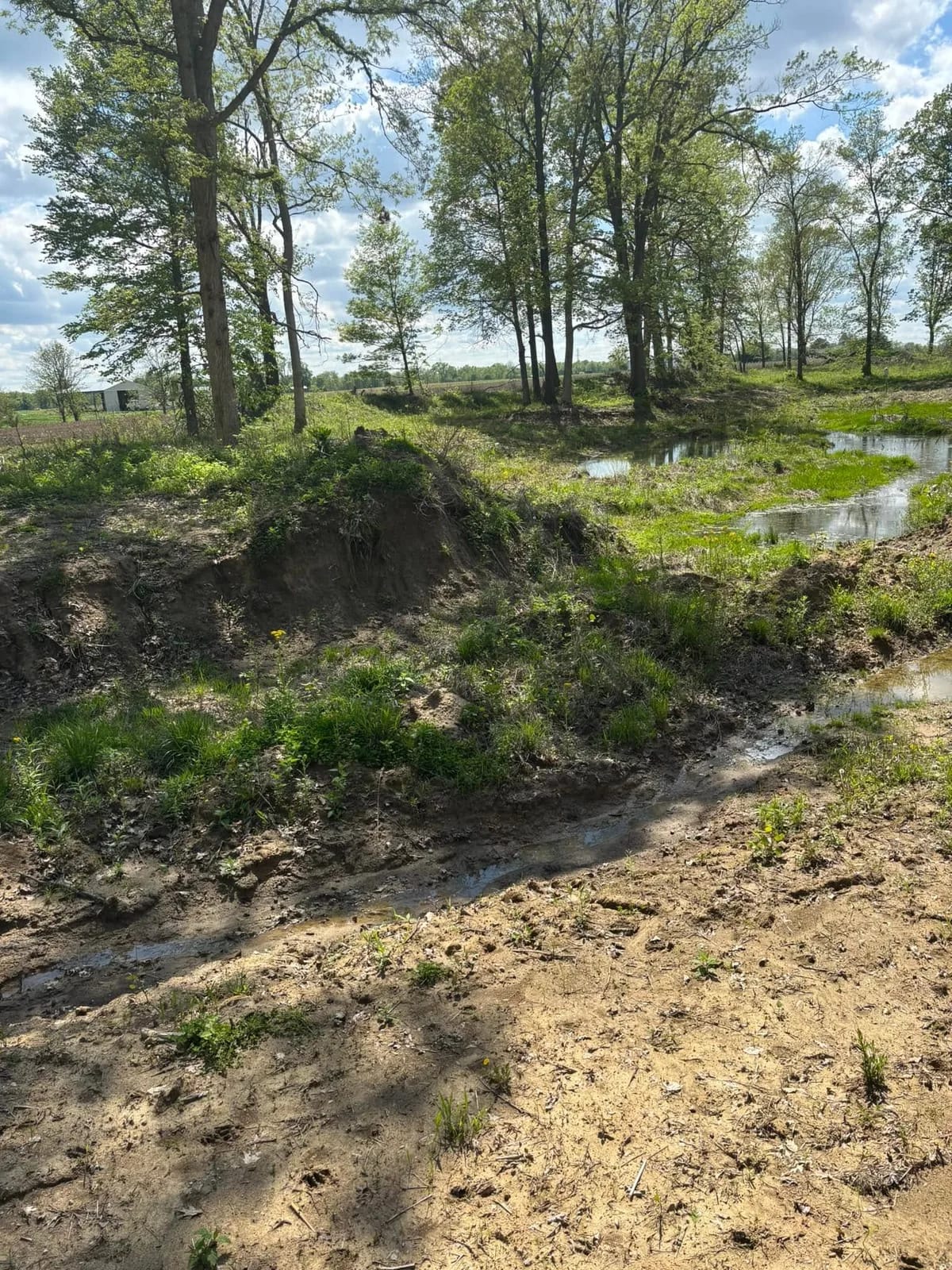
Why K&H
Why Pond Owners Choose K&H Excavating
Most pond dredging companies will give you a price. What sets K&H apart is who sits in the machine and how he reads a pond that's been filling in for decades.
The person who checks your pond and writes the quote is the person in the excavator seat. There's no hand-off to someone who never saw where the creek comes in.
A wet pond bottom is heavy, sloppy work. K&H brings excavators to dig and load, and dozers to spread and shape the spoil.
Kory comes from a Parke County cattle and hay family, so he walks the field above your pond as carefully as the pond itself and will point out the gully, bare ditch bank, or cattle crossing that's feeding it.
Kory walks the banks and checks the sediment before you get a price, at no charge. Calls and texts are answered Monday through Saturday, 8 a.m. to 6 p.m., and texts after hours too. Meet Kory and see how K&H got its start.
How it works
How Our Pond Dredging Works
Step 1 — Walk the Banks With Kory
Kory meets you at the pond, walks the inlet and outlet, and checks how deep the sediment runs. He'll ask what you want back (fishing depth, livestock water, or open water for swimming), since that sets how far down he digs. You'll hear whether the pond needs a full cleanout, an inlet dig, or a deepening, and a written quote follows the walk-through.
Step 2 — Locates, Permit Check, and a Drawdown Plan
Indiana law requires a call to Indiana 811 at least two full working days before any digging, and Kory makes that call. A pond in a floodway, or a spoil area that disturbs an acre or more, can mean a permit. The landowner or permit holder files that paperwork, and Kory will tell you on the walk-through what's likely needed before a machine moves. For a drawdown, he plans how the water leaves (drain valve, siphon, or pump) and talks through with you what to do about the fish.
Step 3 — Dig and Load
Once the bottom has drained enough to work, or from the bank if the water stays in, the excavator digs to the pond's original bottom and loads trucks or a stockpile while the dozer spreads spoil. Want to check on progress? Text Kory, after hours included.
Step 4 — Shape and Stabilize
Kory dresses the pond edges, grades the spoil area to drain, sets silt fence around stockpiles, and seeds the bare ground before the next storm can wash it back in.
Step 5 — The Final Walk-Around with Kory
Kory takes you around the refilling basin to check the new depth, the edges, the spoil area, and the inlet, and points out what upstream would slow the next round of filling.
How we quote
How Much Will Dredging Your Pond Run in West Central Indiana?
K&H prices each dredging job after Kory has seen the pond, because the bill follows how much sediment comes out and where it goes. Clemson Extension names sediment volume as a principal cost factor. For scale, one foot of sediment across one surface acre is about 1,613 cubic yards (43,560 cubic feet ÷ 27). Our pond dredging cost guide works through the math in detail.
K&H takes cash, check, and credit card. Ask Kory about payment options when he quotes the job.
What changes the price
- How many cubic yards come out: sediment depth times the area it covers.
- What it is. Soupy organic muck takes more handling and drying time than firm mineral silt.
- Drawdown. Opening a drain valve is simpler than pumping a pond down.
- Access. Machines and trucks need a firm route to the bank; soft ground, timber, and fences add time.
- Spoil. Spreading it on your ground costs less than hauling it off, and haul distance matters.
- Shaping. Re-cutting edges or digging deeper than the original bottom adds time.
Quoted separately
- Making the pond bigger or deeper than it was built (pond excavation and enlargement)
- Fish salvage, restocking, aeration, or docks, which fall outside the dredging quote
- Engineering or permit fees, if the job needs them (the landowner or permit holder files any permit)
Related work
Often Paired With Pond Dredging
With the machines already on the bank, these jobs often come next.
Pond Excavation & Enlargement
With the water down, it's the cheapest moment you'll ever have to dig the pond deeper or push the edge out. Kory can quote both together. See deepening or enlarging an existing pond.
Pond Silt Removal
If most of the fill sits in a fan at the creek mouth, a targeted inlet dig may be all you need now, and repeating it later keeps the main pond from filling. See pond silt removal at the inlet and forebay.
Silt Pond Maintenance Plans
Lake associations and owners with a silt pond upstream of their main water can schedule cleanouts so sediment gets caught before it reaches the lake. Ask Kory how a cleanout schedule could work for your water. See silt pond maintenance plans for lakes and associations.
More in Pond Dredging: Pond Sediment Removal · Pond Dredging Services · Pond Dredging Cost Guide
Where we work
Pond Dredging Across the Wabash Valley and West Central Indiana
K&H works out of Rosedale in southern Parke County, with Big Raccoon Creek just north of town. Dredging jobs within about 50 miles are routine, and for bigger cleanouts Kory will travel up to about 75 miles, eastern Illinois included. Counties inside that core include Parke, Vigo, Clay, Vermillion, Putnam, Fountain, and Montgomery. US-36 runs east past Cecil M. Harden (Raccoon) Lake through Danville toward Indianapolis. Terre Haute is about 16 miles away by US-41 south, and US-41 runs north to I-74 at Veedersburg, where IN-25 carries on to Lafayette. County roads reach IN-59 at Brazil, and IN-46 runs east from there to Bloomington. West of us, IN-163 crosses the Wabash at Clinton toward Illinois.
What fills a pond changes across that map. On the flat till plain toward Lafayette, fine field soil washes in off row crops. In Vigo and Clay counties, ponds sit near old strip-mine ground. Around Bloomington, NRCS warns that hidden crevices in limestone can drain a pond, so a cleanout there stops at the original clay bottom.
Searching for pond dredging near Terre Haute or Lafayette? We serve Rosedale, Terre Haute, Bloomington, Lafayette, and Indianapolis. See all of K&H's excavation services.
Not sure if your pond is in range? Call or text Kory at (765) 548-3704.
Questions
Pond Dredging FAQ
How do I know if my pond needs dredging?
The clearest sign is lost depth: open water turning shallow enough to see bottom, with rooted plants spreading. Purdue Extension notes that four feet or more of water stops rooted plant growth, so as a pond gets shallower than that, weeds move in. A silt fan at the inlet and cattle bogging down at the edge are other signs. Kory can tell you on a free walk-through how much sediment is there.
How often does a pond need to be dredged?
It depends on how much soil your watershed sends in, so there's no single number. A pond fed by bare cropland or an active gully fills far faster than one ringed by grass. Purdue recommends inspecting a pond at least once a year to catch filling early. A grass filter strip or a silt trap at the inlet stretches the time between cleanouts.
Do you have to drain a pond to dredge it?
Not always. Drawing the pond down lets the bottom firm up so the excavator can dig it clean, which usually gives the most complete job. Where a pond can't be drawn down, or only the edges and inlet need work, K&H can dig from the bank with the water in. Our pond dredging services page compares the methods.
Does K&H do hydraulic dredging?
No. K&H dredges mechanically, with excavators and dozers. Hydraulic dredging pumps sediment through a pipeline and needs a separate place to dewater it. For most farm ponds here, a drawdown and an excavator gets the job done, and if yours is a case where hydraulic fits better, Kory will tell you.
Do I need a permit to dredge my pond in Indiana?
It depends on the pond. The federal Clean Water Act exempts construction and maintenance of farm or stock ponds from Section 404 permits, with exceptions. Many Indiana lakes count as public even without public access, and Indiana DNR says dredging those almost always needs a Division of Water permit. Floodway work, or disturbing an acre or more, can bring in other permits, and Kory flags those during his first visit.
What should I ask pond dredging contractors before hiring one?
Ask how they measure the sediment before quoting, where the spoil will go, and whether they stop at the original bottom so they don't cut through the clay seal. Ask who runs the machine. At K&H, Kory runs every job himself, with excavators and dozers — no skid steers.
When is the best time of year to dredge a pond?
Summer and fall, when the ground is dry enough to carry machines and trucks. Indiana DNR's pond booklet suggests draining a pond in fall so spring runoff refills it. April and May are the wettest months here, so spring jobs often wait on weather. Job length depends on volume, drying time, and weather, so Kory will give you a realistic timeline on the free walk-through.
Ask Kory About My Pond
Still have a question about pond dredging? Call or text Kory at (765) 548-3704.
Call or text
Ask Kory about pond dredging
(765) 548-3704Calls and texts answered Monday to Saturday, 8 a.m. to 6 p.m. Text a few photos of the property and Kory can give you a head start before the site walk.
Get a free estimateFree estimate
Let's Get Your Pond Deep and Clear Again
Tell Kory about your pond, and he'll come walk the banks, check how much has filled in, and lay out the method, the spoil plan, and the number. Send a note through our contact page, or call or text him.