
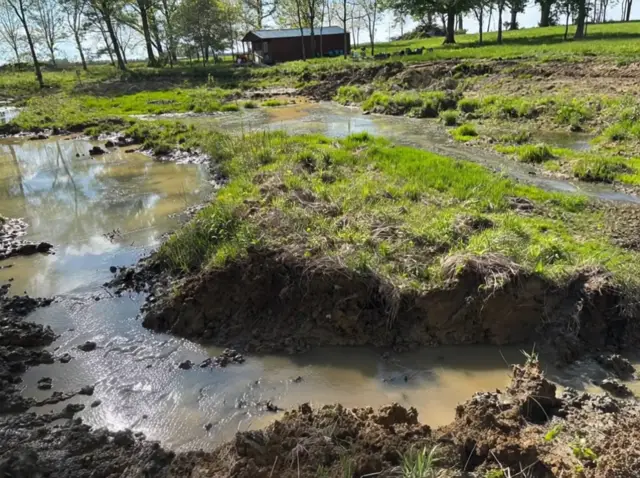
Ponds and lakes · Cost guide
Pond Dredging Cost in Rosedale, IN: How the Price Adds Up
A dredging price starts with the cubic yards of silt on the bottom, then adds what it takes to get the water down, the machines in, and the spoil somewhere it can stay.
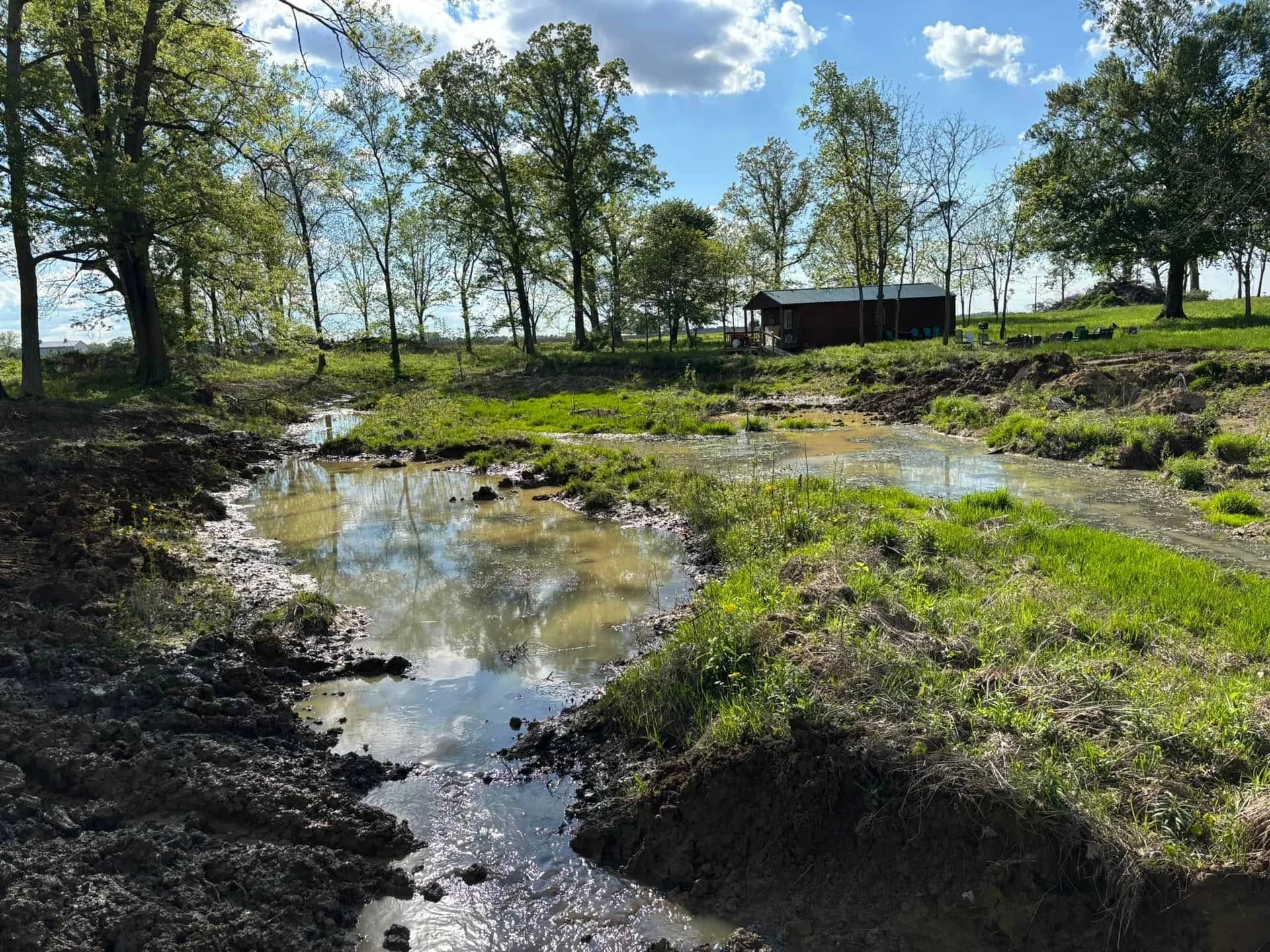
Pond dredging cost comes down to volume first and logistics second. K&H Excavating, a Rosedale excavating company run by Kory Stone in Parke County, prices every dredging job the same way: walk the pond, probe how deep the silt runs, work out the cubic yards, then figure the drawdown, the access, and where the spoil goes. This guide lays out that math so you can rough out your own pond before Kory comes out, whether it's a quarter-acre stock pond off US-41 or a two-acre fishing pond off IN-59. When you want a real number, call or text Kory at (765) 548-3704 and he'll come look at it for free.
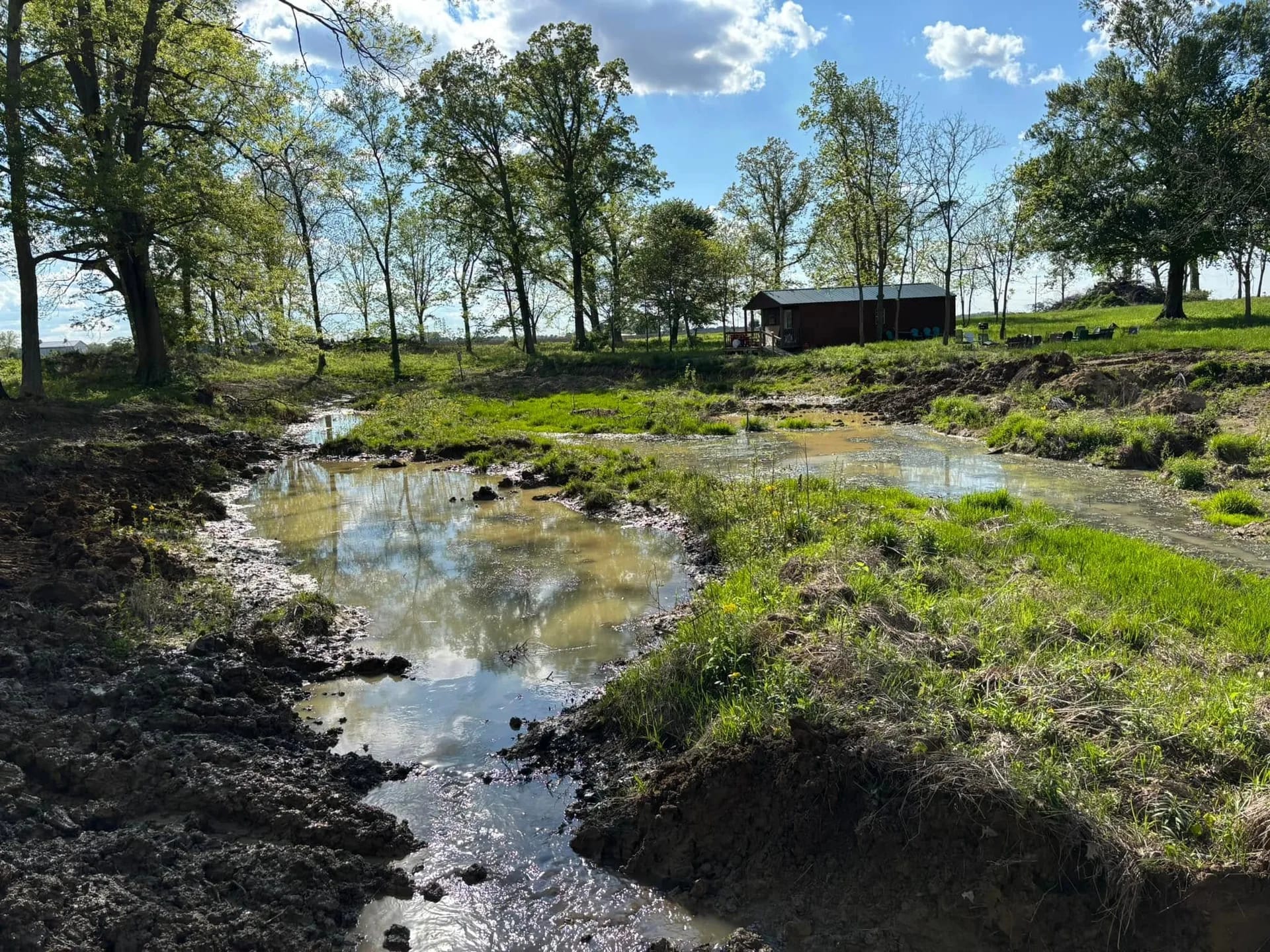
When to call
Signs the Cost to Dredge Your Pond Is Climbing
Waiting almost never makes dredging cheaper. The cost to dredge pond silt rises with every yard that washes in, and every inch of silt spread across one acre is roughly another 134 cubic yards to dig, load, and place (1,613 cubic yards per acre-foot ÷ 12, simple arithmetic). Silt can also come in faster than anyone planned: Iowa State researchers found flood-control ponds there filling 25% faster than their design estimates, mostly from gullies in wooded land upstream.
- A fan of silt is reaching farther out from the inlet every spring.
- The shallow end has gone to cattails, and the open water keeps shrinking.
- A gully, a washed-out field edge, or bare ground upstream is still feeding dirt in.
- Your dock or boat ramp now sits in mud that used to be open water.
- Summer algae blooms and weed mats come earlier every year as the water gets shallower.
- You're getting the pond ready before listing the property or building a house on the hill above it.
What's included
What a K&H Dredging Quote Includes
A K&H quote prices the whole job, from lowering the water to the last pass with the seeder, so you know where the money goes.
Silt Depth Measured Before Pricing
Kory checks the silt depth at points around the pond to find where firm clay starts, and he paces or measures the surface area. Clemson Extension calls the volume of sediment to be removed a principal factor in dredging cost. Ask him to walk you through the readings and the math behind the total.
Drawdown and Drying Time
If your pond has a working drain valve, lowering it costs little beyond time. If it has to be pumped down, expect more time on the front end of the job. Exposed silt then needs to dry before it will carry a machine.
Digging, Loading, and Moving the Spoil
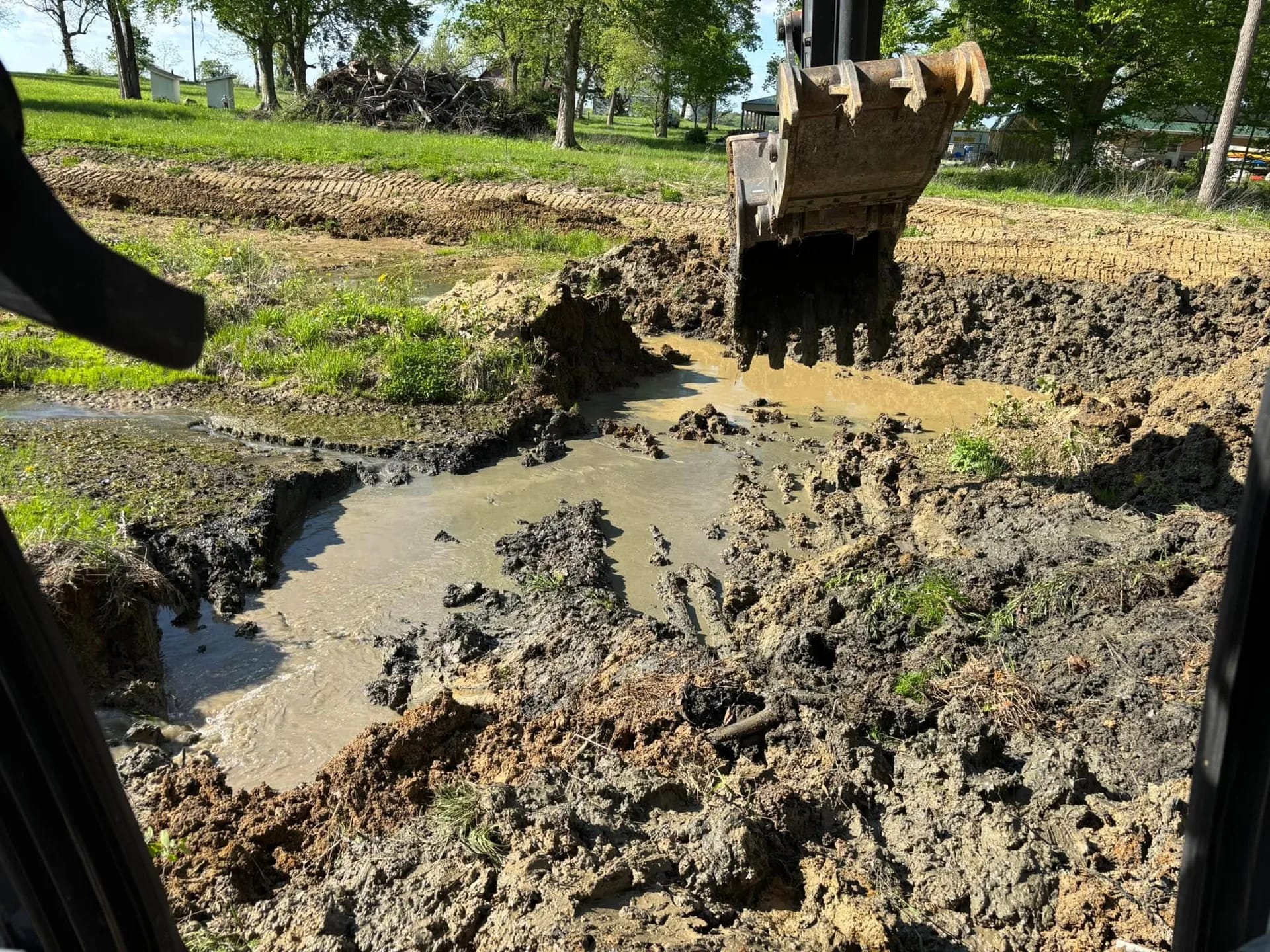
The excavator digs to the original bottom and either loads trucks or piles spoil for the dozer to spread. Where a pond can't be lowered, the excavator digs wet from the bank, and soupy spoil goes to a bermed drying area first. That's more handling, and the quote reflects it.
Spoil Placement, Silt Fence, and Seeding
Clemson recommends placing dredged sediment on upland ground, using double silt fence around stockpiles, and seeding bare soil within two weeks. Hauling it off on K&H's own trucks adds loads and miles.
Local ground
The Price Surprises We See Most in West Central Indiana
A pond bottom is a bowl, so silt runs deepest in the low middle and in the delta where the creek or field ditch comes in. That's why Kory probes before he prices instead of guessing from the bank.
April and May are the wettest months at Terre Haute, about 4.7 inches each. A pond drawn down in spring can refill before the bottom firms up, and that idle time costs money. Scheduling for summer or fall is the cheapest fix there is.
Creek-bottom alluvium covers about 14% of Parke County and 21% of Vigo, per Indiana Geological and Water Survey mapping, and trucks need a firm path across it. On old strip-mine ground in Clay and Vigo counties, IDNR warns that mine spoil is "much looser than the original materials."
Indiana's LARE program says the source of sediment should be addressed before dredging starts. If the gully upstream keeps running, you'll pay again in a few years. A small silt pond at the inlet, cleaned on a schedule through a silt pond maintenance plan, is usually far smaller and easier to clean than the pond it protects. Clemson Extension's dredging guide covers spoil handling and planning in more depth. If the whole basin has filled, see full-basin pond sediment removal.
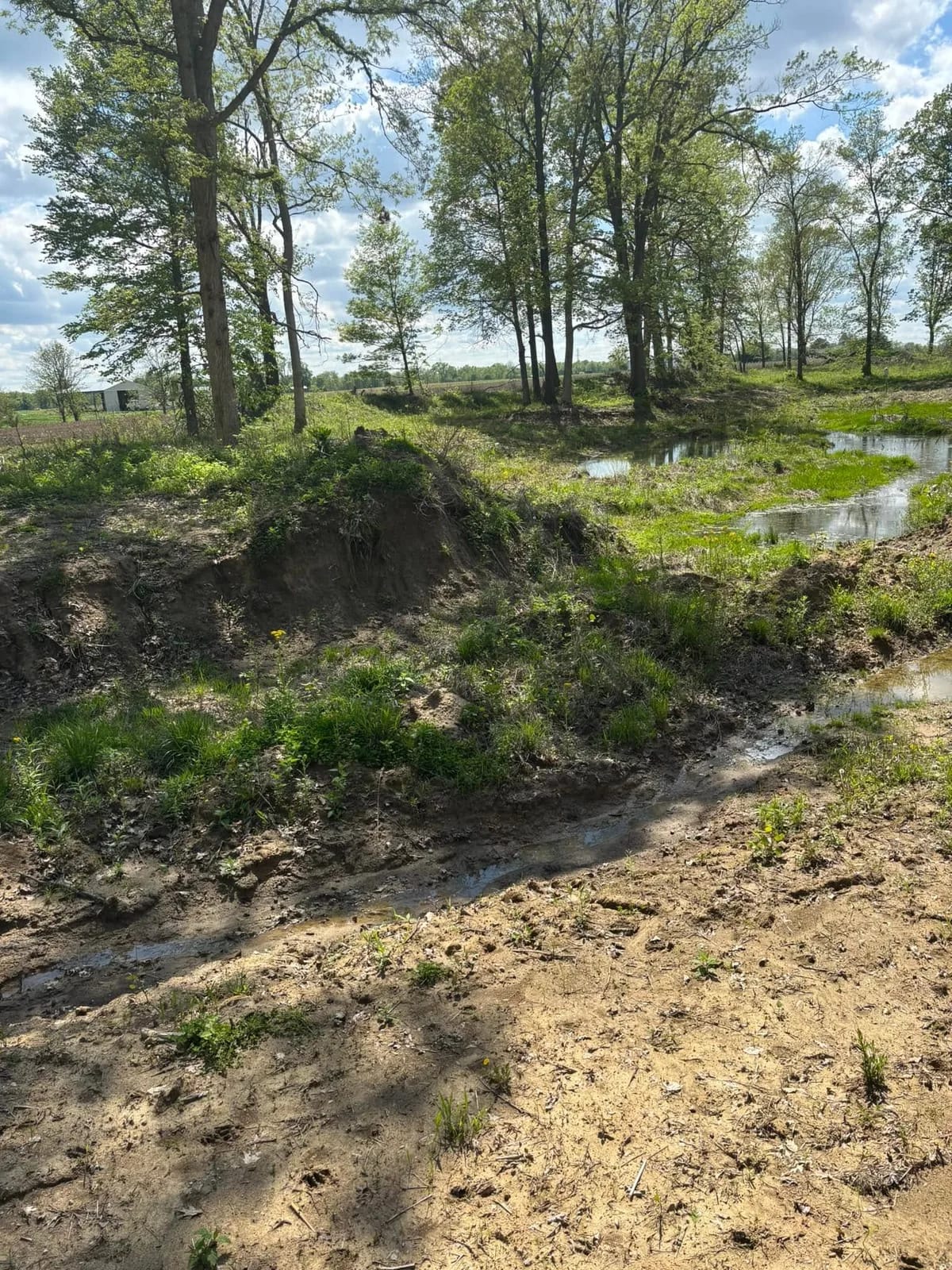
Why K&H
Why Landowners Choose K&H Excavating for a Dredging Quote
A fair price starts with a measured pond and a straight explanation.
Kory drives out, walks the bank, and probes the silt at no charge, so you're never paying to find out what the job costs.
The man who measures your pond is the man who digs it, so the assumptions behind the price don't get lost in a handoff.
Phone hours are Monday through Saturday, 8 a.m. to 6 p.m., and Kory answers texts after hours, so a photo of your inlet sent in the evening gets a reply.
Kory builds the number up from the acreage and the silt depth he found, and you're welcome to ask him to go over that math with you. Get to know Kory and how K&H works.
How it works
How a K&H Dredging Quote Comes Together
Step 1 — Walk and Probe the Pond With Kory
Kory walks the shoreline with you and probes the bottom in a loose grid, with extra readings at the inlet. He checks for a drain pipe, truck access, and a place to spread spoil.
Step 2 — Do the Yardage Math and Pick the Method
Surface acres times average silt depth times 1,613 gives the cubic yards. Kory then picks dry or wet digging and decides whether the spoil stays or goes. If a hydraulic dredge would suit the pond better, he'll say so, since K&H doesn't run one.
Step 3 — Get Your Written Quote
After the walk-through, you get a written price that names the method, the spoil plan, and what's quoted separately. If a permit could apply, Kory will tell you what's likely needed, and the landowner or permit holder files it.
Step 4 — Drawdown, Digging, and Spoil Placement
Kory places the Indiana 811 locate at least two full working days before digging. The water comes down, the excavator digs to the original bottom, and the dozer spreads the spoil. Questions while the machines are running? Text Kory.
Step 5 — The Final Walk-Around with Kory
You walk the cleaned pond with Kory and compare the work to the quote: the depth regained, where the spoil went, and the seeded ground.
How we quote
How Much Does Pond Dredging Cost in West Central Indiana?
K&H prices dredging by the job, after Kory has probed the pond, because the same cubic yard can be cheap to move on one farm and expensive on the next. The cost to dredge pond silt depends on how much there is, how the water comes down, and where the spoil goes. Where a dredging job falls comes down to the yardage and logistics below.
Step One: Turn Your Pond Into Cubic Yards
An acre-foot is the volume that covers one acre one foot deep, or 43,560 cubic feet (U.S. Geological Survey). Divide by 27 cubic feet per yard and one acre-foot is about 1,613 cubic yards. That last figure is simple arithmetic, not a published standard. Multiply your pond's surface acres by its average silt depth in feet, then by 1,613:
Quarter acre with 1 foot of silt: 0.25 acre-foot, about 403 cubic yards
Half acre with 18 inches of silt: 0.75 acre-foot, about 1,210 cubic yards
One acre with 1 foot of silt: 1 acre-foot, about 1,613 cubic yards
One acre with 2 feet of silt: 2 acre-feet, about 3,227 cubic yards
Two acres with 2 feet of silt: 4 acre-feet, about 6,453 cubic yards
Use the average depth, not the deepest spot. Silt is thickest at the inlet and in the middle and thin along the dam, which is why the probe readings matter.
The Cost to Dredge a 1 Acre Pond: A Worked Example
Say Kory probes a 1-acre farm pond and finds about 3 feet of silt in the inlet delta, 2 feet in the deep middle, and under a foot along the dam and edges, for an average near 1.5 feet. That's 1.5 acre-feet, or roughly 2,420 cubic yards. The pond has a working drain valve, the job is set for late summer, and the owner has a hay field next to the pond where the spoil can be spread and seeded. That's about as simple as a 1-acre dredge gets. Change one thing, such as no drain, a fenced yard with no room for spoil, or a spring-fed pond that has to be dug wet, and the price moves.
How Method Changes the Bill
Dry dredging takes drawdown time but gives the excavator a firm bottom. Wet dredging skips the drawdown but handles soupier spoil and only reaches so far from the bank. Hydraulic dredging pumps silt through a pipeline to a settling area or geotextile tubes. K&H doesn't run it, and national guides price it higher than mechanical. See pond dredging services: dry, wet, and hydraulic methods for when each one fits.
Spread It or Haul It
UF/IFAS Extension calls disposal "the biggest challenge for dredging projects" and notes that geotubes are expensive. On a farm, spoil that stays on site, spread thin on a field or used to fill a low spot, is usually the biggest savings available. Trucking spoil off adds loads, fuel, and a place that will take it.
Ways to keep the cost down
Schedule for late summer or fall, and keep the spoil on your property if you have room.
Dredge before the silt grows past reach from the bank.
Fix the gully or bare ground upstream first, and leave a grass filter strip; Purdue Extension notes NRCS recommends a minimum of 66 feet in Indiana.
K&H accepts cash, check, and credit card. If you have questions about paying for a bigger job, ask Kory when he quotes it.
What changes the price
- Cubic yards. More silt means more machine hours and more spoil to place.
- Water control. A working drain valve costs less than days of pumping.
- Method. Digging dry is usually simpler than digging wet and drying the spoil in a bermed area.
- Reach and access. Wide ponds, soft bottomland, timber, and narrow gates add time.
- Spoil. Spreading on site costs less than trucking it away, and every mile of haul adds up.
- Distance from Rosedale. Machines have to be trucked to the pond, and a site 70 miles out takes more getting to than one 7 miles down the road.
Quoted separately
- Clearing brush and trees off the banks for access (brush and underbrush clearing)
- Digging deeper than the original bottom or enlarging the pond (pond excavation and enlargement)
- Permit fees, surveys, or engineering, if the job needs them
- Fish restocking, aeration, and docks, which aren't part of a dredging price
Related work
Often Paired With a Dredging Quote
For the big picture on why ponds fill in, start with our pond dredging overview.
Pond Dredging Services
After volume, the method moves the price most. See how K&H dredges ponds, method by method.
Pond Sediment Removal
If silt has filled the whole basin, the job is a full cleanout back to the original depth. See full-basin pond muck and sediment removal.
Silt Pond Maintenance Plans
A silt pond that gets cleaned out on a regular schedule catches dirt before it reaches the big water. Talk to Kory about what a plan could look like for your water. See silt pond maintenance plans for lakes and associations.
More in Pond Dredging: Pond Dredging · Pond Sediment Removal · Pond Dredging Services
Where we work
Dredging Quotes Across the Wabash Valley and West Central Indiana
K&H is based in Rosedale, in southern Parke County, and quotes dredging within about 50 miles routinely and out to about 75 miles for larger ponds, including eastern Illinois. Counties close to home include Parke, Vigo, Clay, Vermillion, and Putnam. US-41 south and Rosedale Road both reach Terre Haute, where I-70 runs west toward the Illinois line. County roads lead to IN-59 at Brazil, and IN-46 continues east through Spencer to Bloomington. US-41 north heads to I-74 and Lafayette, and US-36 runs from Rockville past Raccoon Lake to Indianapolis.
Ground changes the price as much as distance. Around Bloomington, pond bottoms sit on red clay over limestone with sinkholes, so Kory digs to the old bottom and stops there. Across Parke County's 646 farms (USDA 2022 Census of Agriculture), a common case is a stock pond with a silted inlet and a hay field beside it for spoil.
Want a dredging price near Terre Haute or Indianapolis? We serve Rosedale, Terre Haute, Bloomington, Lafayette, and Indianapolis. See all of K&H's excavation services.
Not sure if your pond is in range? Call or text Kory at (765) 548-3704.
Questions
Pond Dredging Cost Guide FAQ
What's the cost to dredge a 1 acre pond?
It depends mostly on how much silt is in it. A foot of silt across an acre is about 1,613 cubic yards, and two feet is about 3,227. Drawdown, access, and whether the spoil stays on site move the price from there. Kory puts a written number on your pond after the free walk-through.
Why doesn't K&H publish a price per cubic yard?
Because the same yard costs very different amounts to move. Spreading spoil next to the pond is a different job from trucking it ten miles, and digging a dry bottom is different from reaching into water from the bank. Kory prices the whole job instead, built from the yardage.
Is it cheaper to dredge my old pond or build a new one?
Sometimes a new pond is the better buy, especially when the old one is shallow, leaks, or has filled nearly to the top. A Purdue botanist's advice for a dark, mucky old pond is blunt: dig it out and start over. Compare your dredging quote with our guide to the cost to build a new pond, and ask Kory to price both.
Does draining the pond add to the cost?
A pond with a working drain valve costs little to lower beyond time. One that has to be pumped down takes longer, and that time is part of the job. If it can't be lowered at all, the work is done wet from the bank, which changes how the spoil is handled.
Do you charge for the estimate?
No. K&H offers free on-site estimates, and the person who gives it is the person who does the work: Kory, on every job. Want to start with photos? Kory answers texts after hours, so send them any evening.
How often will I need to pay for dredging?
It depends on how much dirt your watershed sends in. Angi's 2026 national guide says most residential ponds need dredging every five to 15 years, but a pond below a gully or bare field can fill faster.
Ask Kory to Price My Pond
Still have a question about pond dredging cost? Call or text Kory at (765) 548-3704.
Call or text
Ask Kory about pond dredging costs
(765) 548-3704Calls and texts answered Monday to Saturday, 8 a.m. to 6 p.m. Text a few photos of the property and Kory can give you a head start before the site walk.
Get a free estimateFree estimate
Let's Put a Real Number on Your Pond
Tell Kory where your pond is, and he'll come probe the silt, measure it up, and give you a price built from what he finds. Reach him through our contact page, or call or text directly.