Ponds and lakes
Silt Pond Maintenance in Rosedale, IN
Is the cove where the creek comes in getting shallower every summer? Is the little basin above your lake already half full of mud? Every yard of silt caught upstream is a yard nobody has to dredge out of the lake.
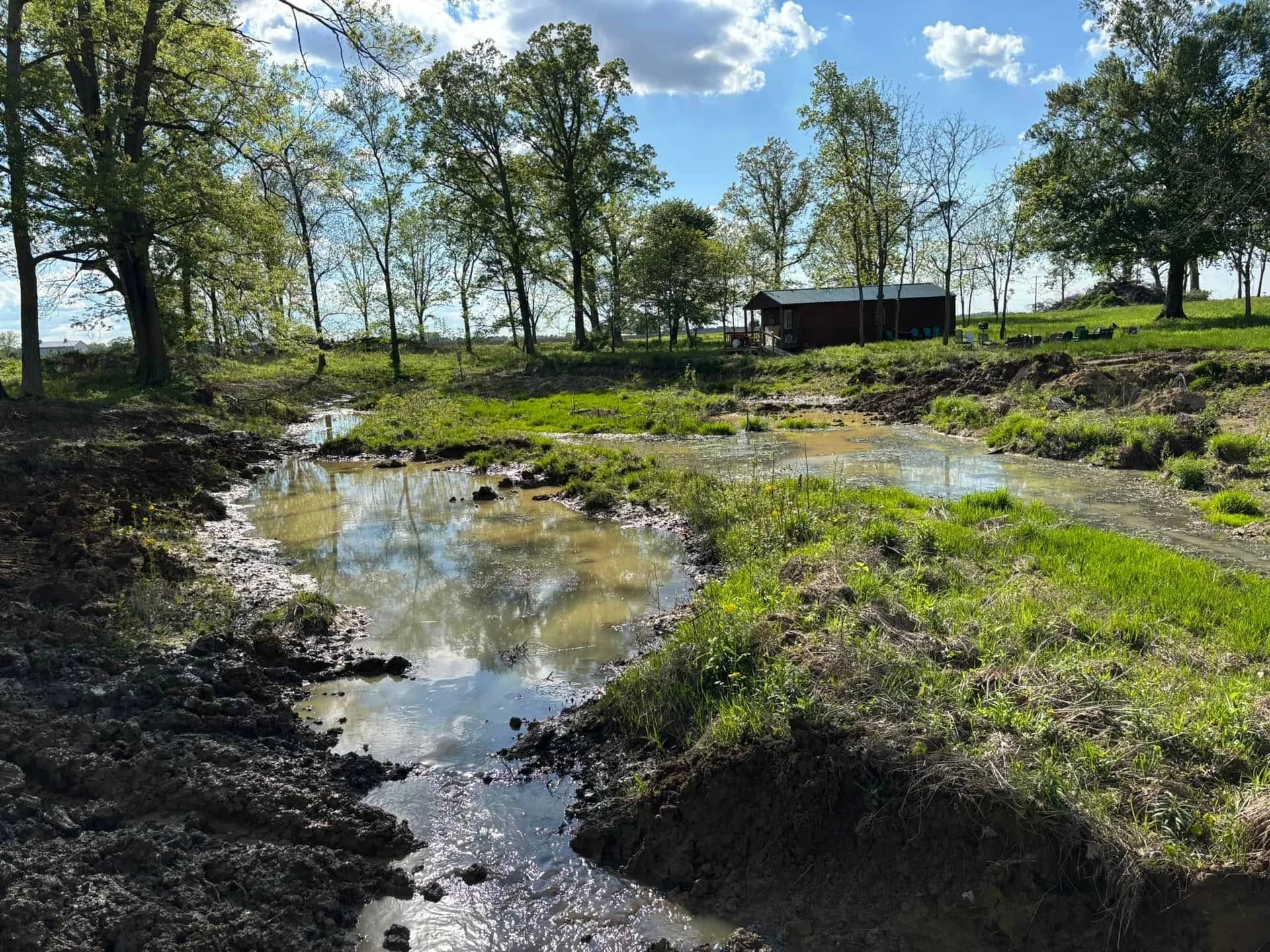
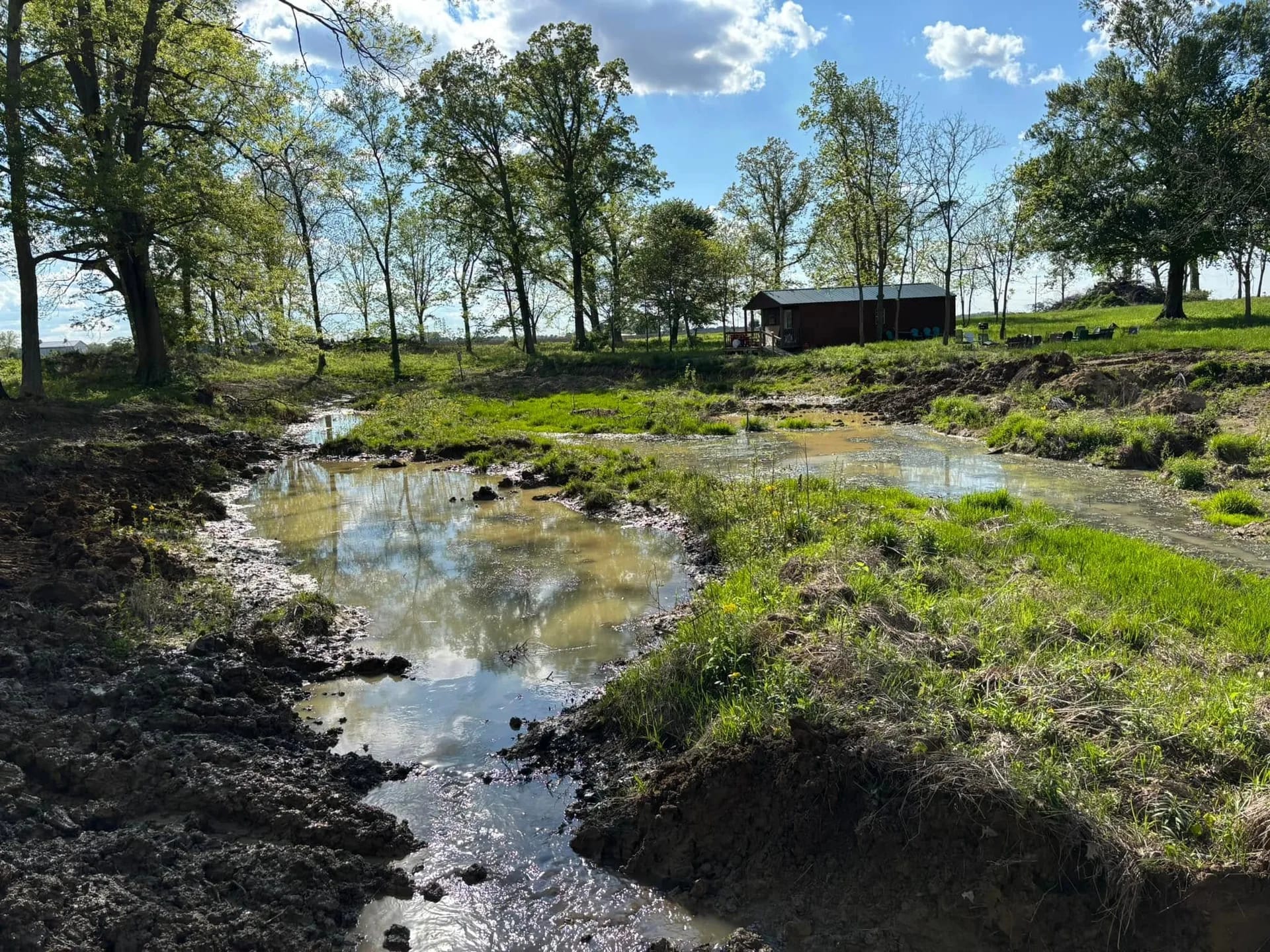
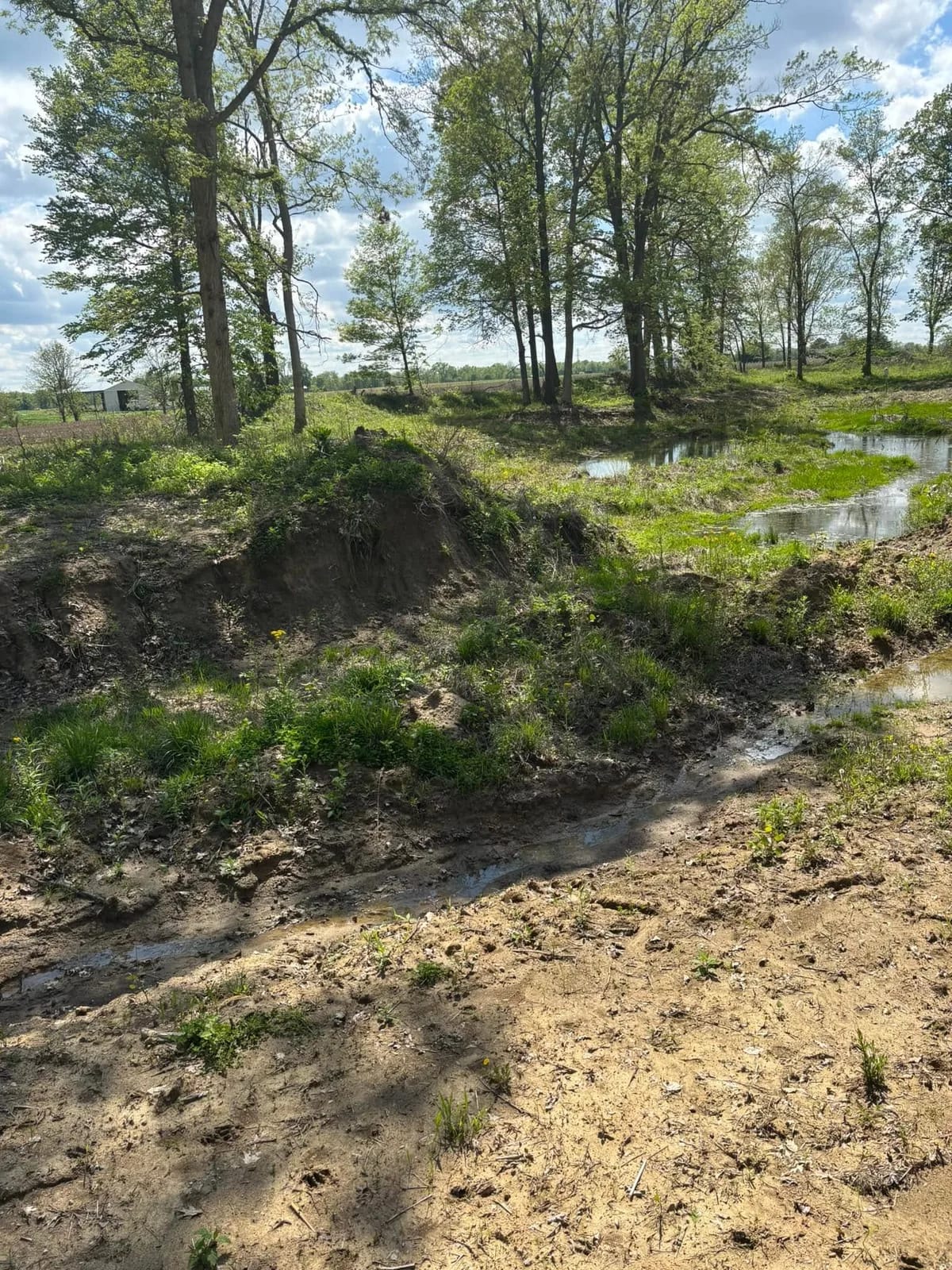
A silt pond is the cheapest protection a lake has: a small basin, sometimes called a sediment basin or forebay, built where a creek, ditch, or storm pipe comes in, so mud settles out before it reaches open water. K&H Excavating handles silt pond maintenance for lake associations, private lake owners, and commercial properties across west central Indiana. We're a Rosedale excavating company owned by Kory Stone and based in Parke County, less than a mile from Big Raccoon Creek, the creek that was dammed to form Raccoon Lake. Kory checks how full each basin is, digs the sediment out with excavators and dozers before it spills through, and puts the inlet and berm back in shape. Call or text Kory at (765) 548-3704 and he'll come walk your basins.
When to call
Signs It's Time for a Sediment Basin Cleanout
A silt pond only works while it has room left. Once the storage fills, the next storm pushes muddy water straight across the top and into the lake, where the same silt is spread thin over coves and beaches and costs far more to get back out. A lake dredge can mean a drawdown, long reach, and sometimes a state permit; a basin cleanout is an excavator on the bank. Watch for these:
- The cleanout stake at the halfway mark is buried, or nobody can find it anymore.
- A mud flat has built out from the inlet, and cattails or willow sprouts are rooting on it.
- After a hard rain, a brown plume runs past the basin and fans out into the lake.
- Water cuts around the end of the basin or over the berm instead of leaving through the outlet.
- Coves, docks, and the swimming area below the basin are going shallow faster than they used to.
- Ground upstream changed hands: a field went to row crops, a subdivision broke ground, or timber was logged.
- The association is setting next year's budget, or a lake drawdown is planned and you want the basins cleaned first.
What's included
What Our Silt Pond Maintenance Includes
Silt pond maintenance means measuring how much sediment a basin is holding, removing it before the basin loses its ability to catch more, and keeping the inlet, berm, and outlet sound so the next storm's mud stops where it's supposed to.
Reading the Basin Before Anyone Digs
Kory starts at the cleanout stake, if there is one, and probes sediment depth at the inlet, the middle, and the outlet end. He walks the berm for slumps, seeps, and burrows, checks the outlet for trash and woody debris, and looks at where the water came from: a field waterway, a road ditch, or a gully in the woods. NRCS Practice Standard 350 for sediment basins calls for periodic inspection of the structures, embankments, and spillways, and that's the checklist he works from.
Digging the Sediment Forebay Back to Its Bottom
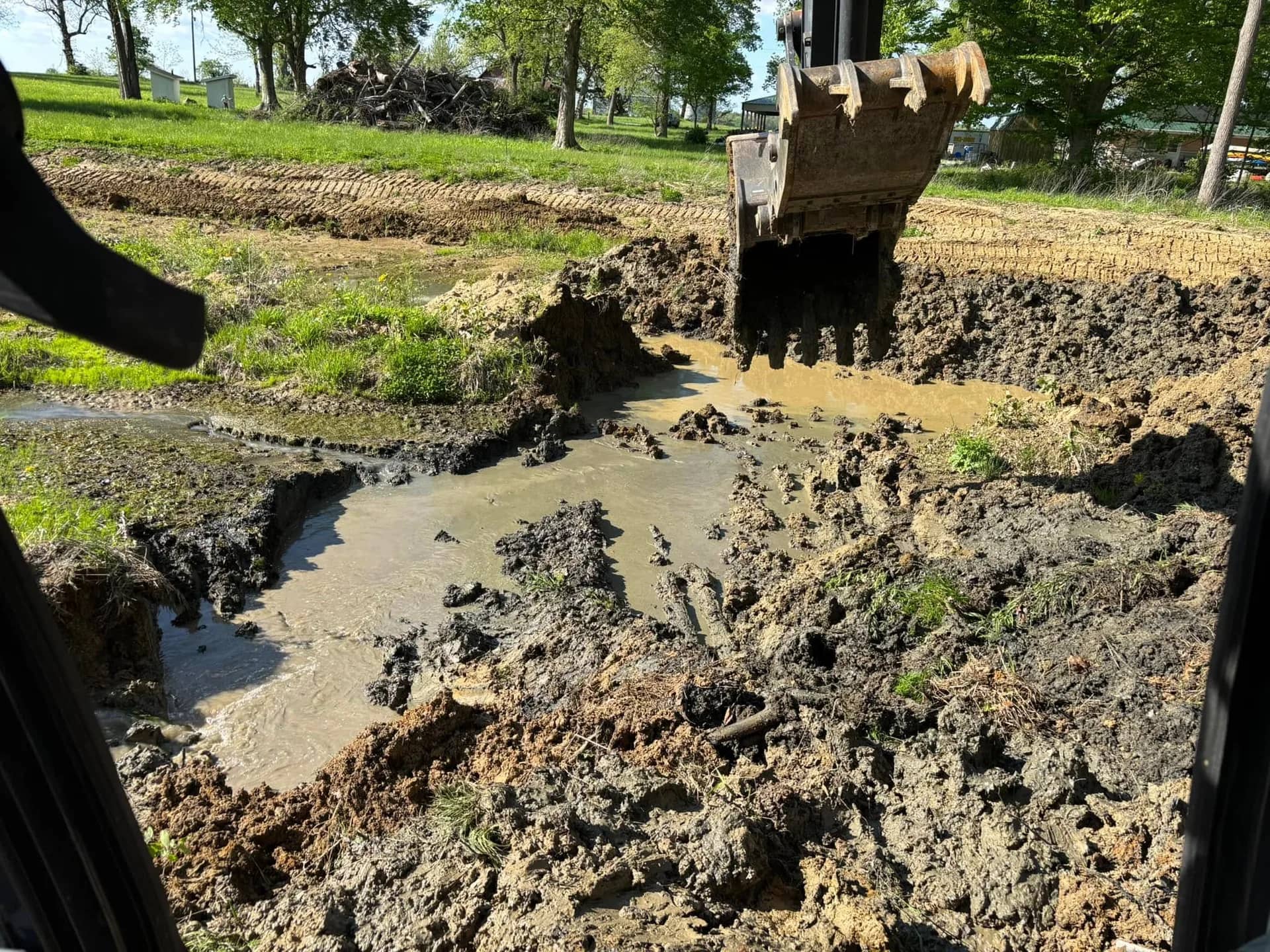
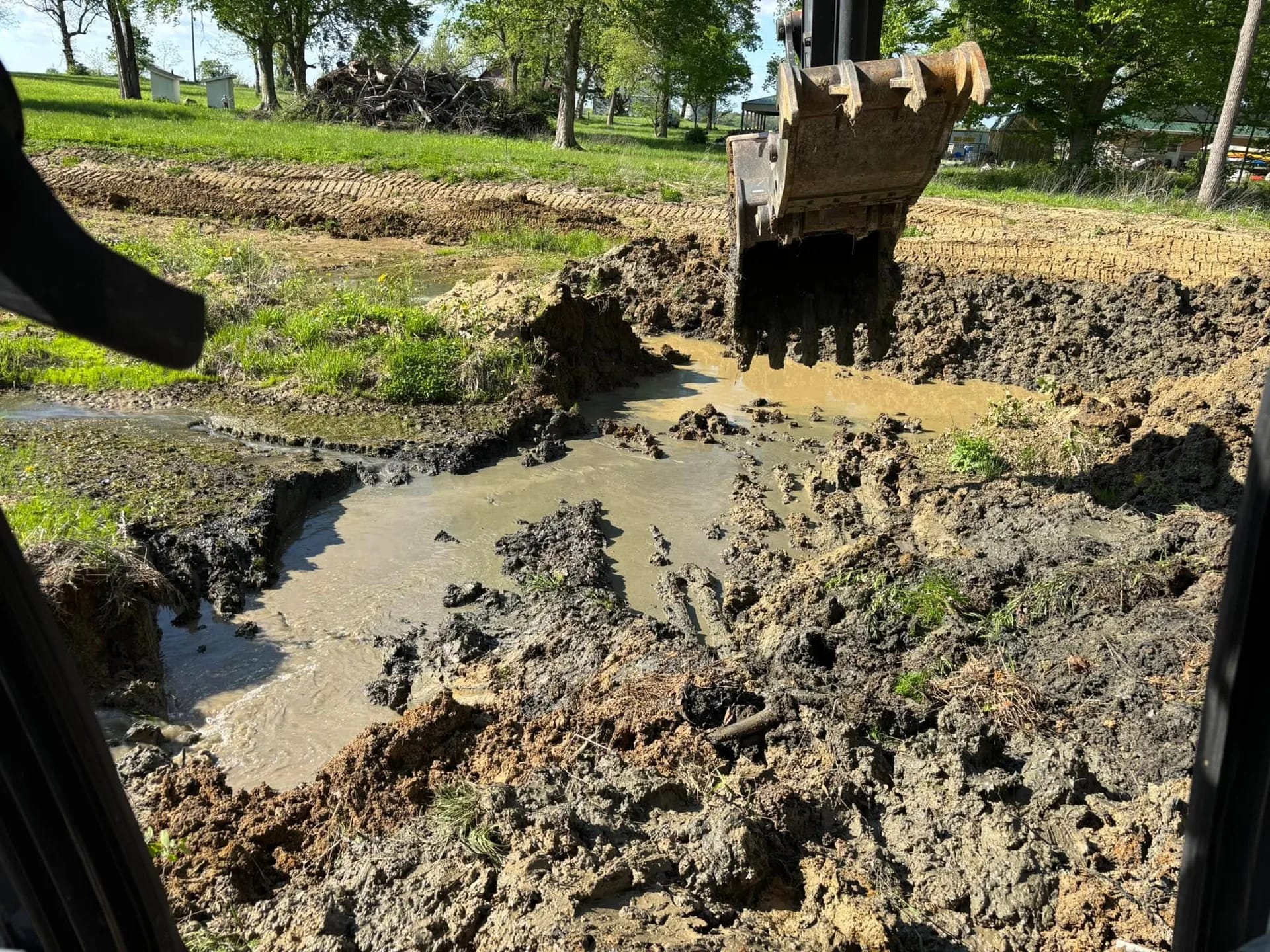
When the basin is ready, the water comes down first if the basin can be drained or pumped down, and then Kory digs the silt out with an excavator working from the bank. The goal is the original bottom of the sediment forebay, not just a scoop off the top, so the basin has its full storage back. A dozer pushes and shapes the spoil, and trucks move it where it needs to go. On a wide basin, a long-reach excavator comes in when the middle is out of normal reach.
Rebuilding the Inlet and the Berm
Silt ponds wear out at the inlet first. Kory reshapes the inlet channel, sets rock where the incoming water hits, rebuilds any low spot in the berm so overflow goes where it was designed to go, and clears trees and brush off the embankment. NRCS 350 lists periodic removal of trees and brush as routine upkeep, and roots left in a berm can open seep paths.
Spoil, Seeding, and Depth Readings
Dug silt goes to an upland spot outside the floodplain, either spread on your ground or hauled off. Clemson Extension recommends seeding bare spoil within two weeks so it doesn't wash right back in. After each cleanout, Kory goes over the before-and-after depths with you, so you know how much storage the basin has back.
Local ground
The Silt Pond Problems We See Most in West Central Indiana
Spring is the wettest season here. April and May each average about 4.7 inches at Terre Haute (NOAA 1991–2020 normals), and a stretch of gully-washers can do years of filling in a few weeks. That's why the inspection right after a big spring storm matters more than any other.
Parke County alone has nearly 130,000 acres of cropland (USDA 2022 Census of Agriculture), and wind-blown loess, which is silt by nature, covers roughly 44% of Vigo County and 35% of Clay County. Fine soil like that stays suspended and travels a long way.
Iowa State researchers reported in 2026 that flood-control ponds there filled with sediment 25% faster than their design estimates, mostly from gullies in wooded ground. A basin built for "cleanout every few years" may need it sooner, and the only way to know is to measure.
IDEM's Indiana Storm Water Quality Manual says to clean a sediment basin when sediment fills half its storage zone, and to set a cleanout stake at that 50% elevation so the trigger is visible (IDEM Storm Water Quality Manual, Section 708.02). That section covers temporary construction basins, but the half-full rule fits a permanent silt pond too. If a basin has already overflowed and left a delta at the inlet, a one-time pond silt removal job gets it back to depth. If the silt has already reached the lake, that's lake dredging.
Why K&H
Why Lake Associations and Property Owners Choose K&H Excavating
Commercial pond maintenance companies often mean fountains, algae treatments, and mowing. K&H handles the dirt side, the part that decides whether a basin catches silt at all.
The person who reads your cleanout stake is the person who runs the job and goes over the depths with you afterward. You aren't explaining your lake to a new face every season.
A full basin of wet silt needs reach and weight. K&H digs with excavators, shapes with dozers, and hauls with its own trucks, so the basin goes back to its original bottom instead of getting a shallow scrape.
Storms don't keep office hours. Calls are answered Monday through Saturday, 8 a.m. to 6 p.m., and you can text Kory a photo of a blown-out inlet at 9 at night and hear back.
Kory's family has farmed cattle and hay in Parke County, so he knows what a bare field, a washed-out waterway, or a broken tile outlet does to a creek. He'll point out the upstream source, not just dig the symptom. Learn about Kory and how K&H works.
How it works
How Our Silt Pond Maintenance Works
Step 1 — Walk the Basins With Kory
Kory meets you, your lake manager, or your board and walks every inlet, silt pond, and outlet. He'll ask when each was last cleaned and where muddy water shows up after rain. You get a written estimate for a one-time cleanout, a plan built around your basins, or both.
Step 2 — Set the Cleanout Trigger
If a basin has no stake, putting one at the halfway mark of the sediment storage lets anyone on the association see when it's time. Kory records starting depths as a baseline.
Step 3 — Inspect on a Season-Based Schedule
Inspections follow the seasons, and Kory sets the timing for each site. Spring is the wettest stretch in west central Indiana, so a look after the big spring storms shows how fast a basin fills. Summer and fall are when the ground is firm enough to dig without rutting the berm.
Step 4 — Dig Out When the Stake Says So
When a basin reaches the halfway mark, Kory schedules the cleanout, places the Indiana 811 locate at least two full working days ahead, and digs it back to the original bottom. If the work could fall under a floodway or lake permit, he tells you before work starts what's likely needed, and the owner or association files.
Step 5 — The Final Walk-Around with Kory
You walk the basin with Kory: the new depth, the inlet rock, the berm, and where the spoil went. Then you have the new depth readings to file with your association's records.
How we quote
How Much Does Silt Pond Maintenance Cost in West Central Indiana?
Kory prices silt pond work after walking the basins, either as a one-time cleanout or as a plan that can include inspections and scheduled dig-outs, with terms Kory sets for each site. The silt pond maintenance plans page covers how a yearly plan is set up.
K&H takes cash, check, and credit card. If you need to spread out the cost, bring it up with Kory when he quotes the work.
What changes the price
- How much silt is in the basin. As arithmetic: an acre-foot is 43,560 cubic feet, or about 1,613 cubic yards, so a quarter-acre forebay holding 2 feet of silt has roughly 800 cubic yards to move.
- Water. A basin that can be drained or pumped down digs faster than one worked wet.
- Access. Soft banks, timber along the berm, and long carries to the spoil area add machine time.
- Spoil. Spreading on site costs less than trucking it off.
- Inlet and berm repairs, including rock at the inlet.
- How many basins are on the lake and how far apart they sit.
Quoted separately
- Silt that has already reached the lake (lake dredging)
- Aquatic weed treatment, aeration, fish stocking, and mowing
- Engineering or permit fees, if a basin falls under a floodway or lake permit
Related work
Often Paired With Silt Pond Maintenance
With the basins in shape, these come up next.
Silt Pond Maintenance Plans
If your basins fill every year or two, scheduling inspections and dig-outs ahead beats calling after the lake turns brown. A plan is built around how fast your basins fill, and Kory sets the terms for each site. See yearly silt pond maintenance plans for lakes and HOAs.
Pond Silt Removal
A basin that has gone years without attention usually has a delta at the creek mouth and needs a one-time dig back to design depth before a plan makes sense. See one-time pond silt removal at inlets and forebays.
Lake Dredging
When silt has already filled the coves below the basin, the lake itself needs attention. That's a bigger project, with more planning and permits involved. See lake dredging for private lakes and associations.
More in Silt Pond Maintenance: Silt Pond Maintenance Plans · Pond Silt Removal
Where we work
Silt Pond Maintenance Across the Wabash Valley and West Central Indiana
K&H works out of Rosedale in southern Parke County and takes silt pond work within about 50 miles as a matter of course, and up to about 75 miles for lakes with several basins, including eastern Illinois. From Rosedale, US-41 north to Rockville picks up US-36, which runs east past Raccoon Lake through Bainbridge and Danville into Indianapolis. That corridor crosses Putnam and Hendricks counties, where the DNR's lake association directory lists several conservancy-district lakes. US-41 south reaches Terre Haute in about 16 miles. County roads lead to IN-59 at Brazil, then IN-46 runs east through Spencer to Bloomington. For Lafayette, it's US-41 north to I-74 and IN-25.
Watersheds change across that ground. North and east of Rosedale it's mostly glacial till farmland, so silt comes off fields and waterways. Vigo and Clay counties add wind-blown loess and old strip-mine ground, where IDNR notes mine spoil is much looser than the original soil. Day-to-day work covers Parke, Vigo, Clay, Vermillion, Putnam, and Montgomery counties.
Searching for silt pond maintenance near Indianapolis or a sediment basin cleanout near Terre Haute? We serve Rosedale, Terre Haute, Bloomington, Lafayette, and Indianapolis. See all of K&H's excavation services.
Not sure if your lake is in range? Call or text Kory at (765) 548-3704.
Other services from K&H
Questions
Silt Pond Maintenance FAQ
What is a silt pond, and is it the same as a sediment forebay?
A silt pond is any small basin built to catch sediment before it reaches a larger pond or lake. A sediment forebay is the same idea built right at the head of the lake, usually separated from it by a low berm or rock. Both slow incoming water so silt drops out.
How often does a sediment basin cleanout need to happen?
It depends on the watershed, not the calendar. IDEM's guidance for construction-site basins is to clean when sediment fills half the storage, and NRCS Standard 350 calls for removing sediment when it reaches a set elevation. A University of Kentucky guide puts typical forebay cleanouts around every five years, but basins below row-crop ground or active construction can fill much faster. Measuring after big storms is how you find your number.
How do I know when my silt pond is full?
The easiest way is a cleanout stake set at the 50% storage mark. When silt reaches it, schedule the dig. Without a stake, look for a delta at the inlet, plants rooting in the basin, and muddy water passing straight through after rain.
Do I need a permit to clean out a silt pond?
It depends on where the basin sits. Work in the floodway of a stream draining a square mile or more needs an IDNR permit, and dredging below the shoreline of a public freshwater lake needs a written IDNR permit under the Lakes Preservation Act. A forebay on a stream may also involve Corps of Engineers and IDEM review. Kory will tell you on the walk-through which of these likely applies, and the owner or association files.
Where does the silt go?
Clemson Extension says dredged sediment belongs on upland ground, with silt fence if it's stockpiled, and Kentucky's state conservation guidance adds that it should sit outside the floodplain. Kory either spreads it on your property where it won't wash back or hauls it off.
Do you offer commercial pond maintenance for HOAs and businesses?
Yes, for the sediment and earthwork side: inspections, forebay and basin cleanouts, inlet rock, and berm repair. Kory is on every job himself, so the same person checks your basins every season. Fountains, algae treatment, and mowing are outside K&H's work. See the yearly plan details.
Is cleaning the silt pond really cheaper than dredging the lake?
Usually, because the silt is concentrated in one small basin next to the bank instead of spread across acres of open water. IDNR's lake program policy says the source of sediment should be addressed before a lake is dredged. Lake Santee in southeast Indiana built a roughly one-acre basin where its creek enters, with the stated goal of cutting future dredging costs.
Ask Kory About My Silt Pond
Still have a question about silt pond maintenance? Call or text Kory at (765) 548-3704.
Call or text
Ask Kory about silt pond maintenance
(765) 548-3704Calls and texts answered Monday to Saturday, 8 a.m. to 6 p.m. Text a few photos of the property and Kory can give you a head start before the site walk.
Get a free estimateFree estimate
Let's Catch the Silt Before It Reaches Your Lake
Tell Kory how many basins feed your lake and when they were last cleaned. He'll walk them, read the depth, and give you a straight answer on whether to dig now, put them on a plan, or wait. Reach him through our contact page, or call or text directly.